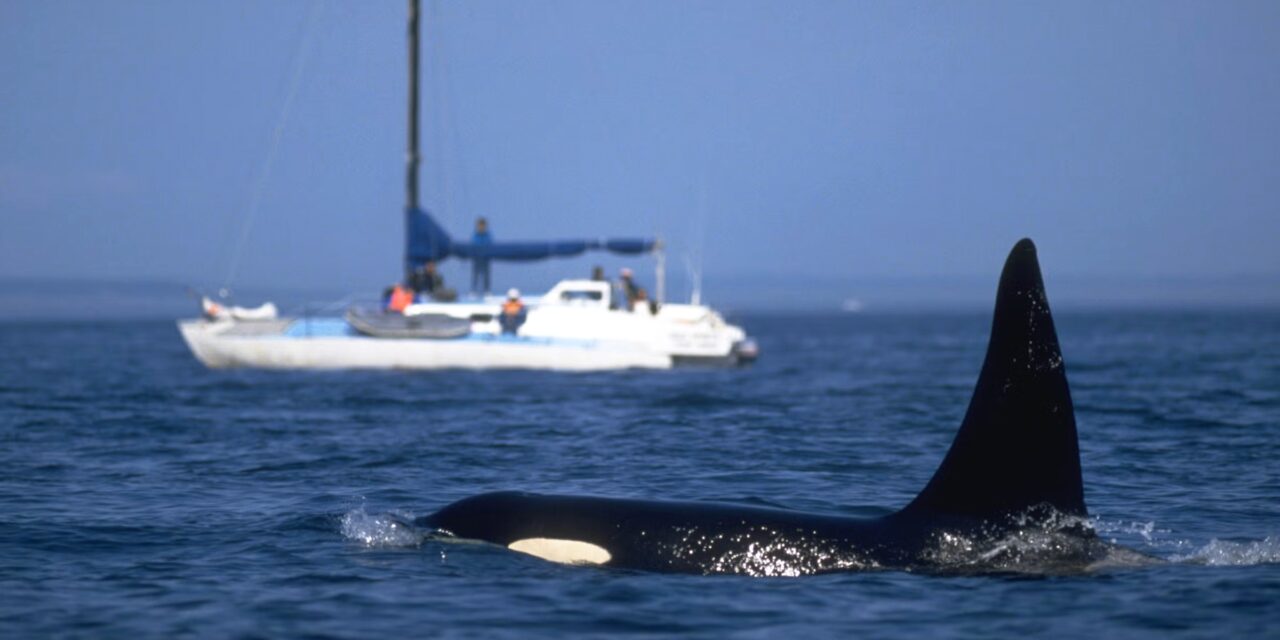
Did you know that a species of Orca has been attacking boat rudders of sailboats and catamarans off the Iberian Peninsula of Spain and Portugal? This mysterious behavior first started in 2020 and has continued through 2025. This seemingly learned Orca behavior has spread to other areas like Morocco and France, with over 700 boats having been attacked.
First-hand accounts from sailors describe how this subpopulation of endangered Orcas are ramming their heads into boats and biting off rudders of small to medium-sized sailboats. These Orcas have caused serious damage, including opening a hole below the waterline due to the rudder being torn off, causing vessels to sink. The crunch of a several-ton marine mammal moving quickly through the water is not to be underestimated. A full-grown Orca can be 30-feet long. Orcas, also called killer whales, are the largest member of the dolphin family, which in turn are a type of toothed whale.
Iberian Orca attacks typically last less than 30 minutes, but they can sometimes go on for up to two hours. These attacks by Orcas tend to occur in deep waters and sailors have begun hugging the coastline in shallower water to avoid such incidents. Researchers have found that these Orcas prefer attacking only the rudder, sometimes scraping the hull with their teeth. So why is this happening? Orcas are not trying to harm humans but why are they attacking boat rudders? Scientists have several theories:
- Learned Behavior. Orcas share knowledge and have long memories. The attacks could be a learned behavior that spread within and between pods. These killer whales may have invented a new fad, something that subpopulations of the dolphin family are known to do.
- Social Play. Orcas are a socially complex species and each population has its own culture. Play strengthens social connections. One suggestion is that the young Iberian Orcas find the sensation of the moving rudder quite fun and enriching. There’s documented evidence of these Orcas playing with pieces of the rudder after having broken them off. This theory is the most widely accepted.
- Hunting Practice. Another theory is that the Orcas are practicing hunting skills lead by an adult teaching younger Orcas. Their primary prey is the Atlantic bluefin tuna, which is fast and difficult to catch. Orcas must work together as a team to isolate one tuna for the kill. The crew of a sailboat reported that two juvenile killer whales went after their rudder, while an adult repeatedly rammed the boat.
- Boredom. With more abundant bluefin tuna, the Orcas may have more free time after foraging, leading to increased playful or exploratory behaviors. In the Pacific Northwest when there was plenty of salmon to go around in 1987, some members of the Southern Resident Killer Whales wore dead salmon on their heads like hats. The behavior spread and persisted for a few months before disappearing, and then reappeared again in 2024.
- Remembered Trauma. One theory suggests that a specific Orca, possibly an adult called White Gladis, had a negative encounter with a boat (collision or entanglement) and triggered a defensive behavior that was then mimicked by other members of her pod. Most marine biologists, however, emphasize that the behavior is likely linked to play or socializing and not aggression.
To learn more, watch this interesting YouTube video at https://www.youtube.com/watch?v=2ng7FJGwOD0
Photo: Outside Magazine