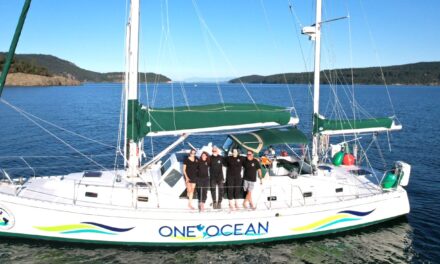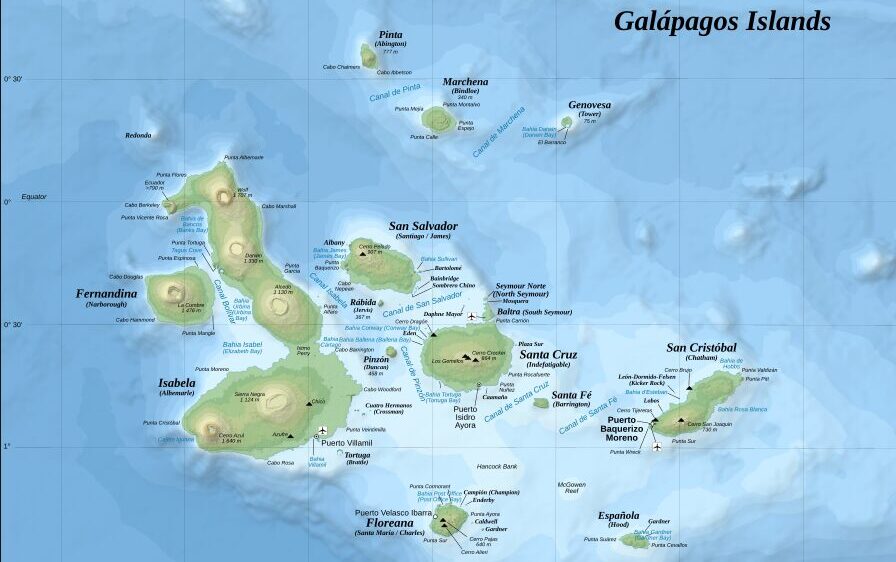
The crew of s/v One Ocean departed Concon, Chile in early May – destination the Galapagos Islands, where they will connect with the Darwin Institute. The volcanic islands of the Galapagos are located around the equator, approximately 600 miles west of mainland South America, and consist of 18 main islands, 3 smaller islands, and 107 islets.
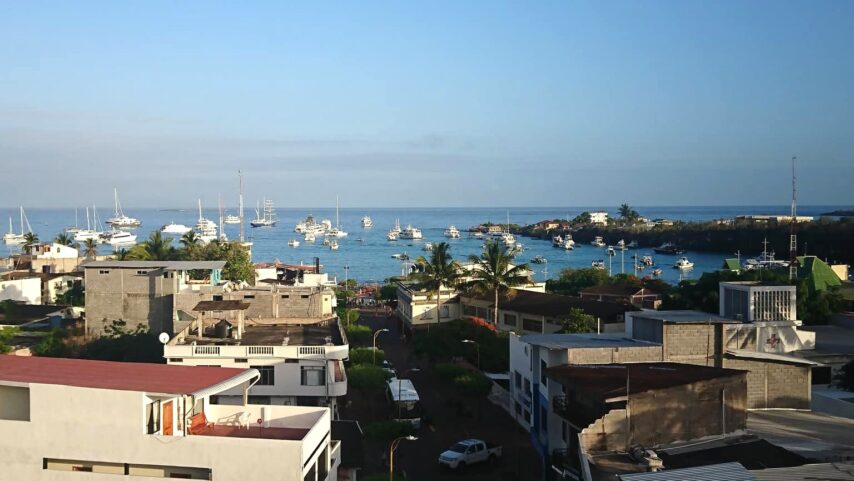
The islands form the Galapagos Province of the Republic of Ecuador, with a population of around 33,000 people in designated human-use areas. Arriving by private boat requires rigorous authorization from the Ecuadorian Ministry of Defense, along with guidelines to protect this pristine area. Boaters may visit park sites with a licensed guide and can only dock their boat with approval at designated ports. The Galapagos, with its large number of endemic species, is where Charles Darwin in the 1830s was inspired to write his theory of evolution.
The Charles Darwin Research Station (CDRS) is a biological research station operated by the Charles Darwin Foundation founded in 1959. The Station has a team of over a hundred scientists, educators, volunteers, research students, and support staff from all over the world. Conservation, habitat protection, and control of invasive species are among the tasks of the Foundation.
Stay-tuned for reports from the Galapagos as shared by the crew of One Ocean during their stay. In the meantime, you can read their story of sailing northwest from Chile and their encounter with large seas during the first 5 days of their journey. The following is an excerpt from Jenn Dalton’s report titled There’s No Certainty at Sea:
My Windy app was predicting gusts into the high 40s, and the wind had already climbed quickly into the mid-30s throughout the day. Mark didn’t think we needed to change sails yet – though later, I realized part of him may already have known we were past the point where it could be done safely. Decisions at sea are rarely black and white. They come from experience, instinct, timing, fatigue, weather models, and countless subtle variables that can’t always be explained. Sometimes you make the right call, sometimes the ocean humbles you anyway.
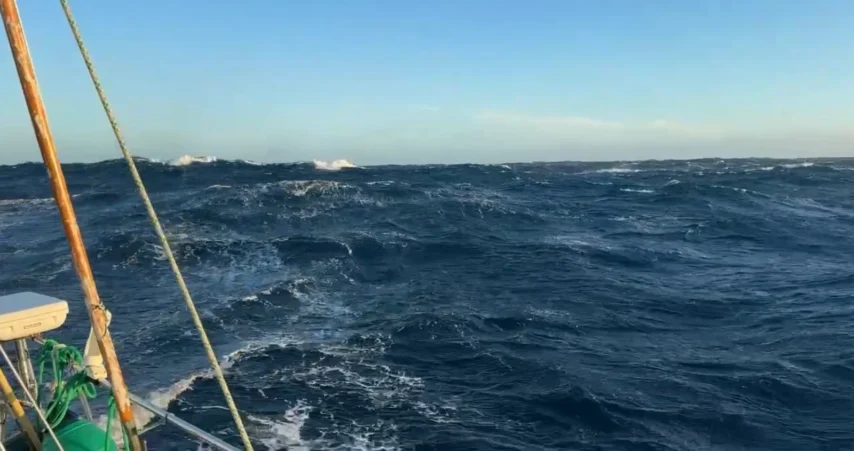
Once the wind climbed into the high 40s and low 50s, the autopilot could no longer keep up, and we had to go out into the darkness and hand-steer – something none of us had the energy for. We were already exhausted, our bodies bruised and battered from being thrown around by every crashing wave for days now, since we’d left Concon, Chile.
Mark climbed to the mast. He was going to lash the sail as best he could. I shimmed along the deck, clipping into the jacklines, when another wave hit us hard and we surfed down the face of a steep swell. . . .Together, Mark and I adjusted the boom to keep us from becoming overpowered. Next came the storm boards for the port-side windows. It took both of us to control the boards once I brought them out into the wind. The gusts tried to rip them from my hands. Kneeling on the narrow side deck, we screwed the boards over the cabin windows, hoping to spare ourselves the trauma of waves exploding against the glass all night long. Back inside, we finalized our preparations by boarding up the cockpit door – just in time before a massive wave crashed into the cockpit, filling it with water.
One Ocean had carried us safely through the night. The storm boards had done their job as wave after wave slammed into them and thundered against the hull. I’ve learned that good decisions are not always perfect ones – they are thoughtful, grounded, and made with the information and instincts you have at that moment. I’ve learned to trust myself. Out here, there’s no room to hide from hesitation, fear, or self-doubt. The ocean exposes all of it.
Map of the Galapagos – Wikipedia
Photo of Puerto Ayora – Galapagos Ministry of Tourism
s/v One Ocean in heavy seas – Crew of s/v One Ocean