Sightings of the invasive European Green Crab have significantly increased over the last few years. These voracious non-native crabs gobble up a variety of shellfish and destroy eelgrass habitats by foraging and burrowing into the seabed. Introduced to California more than three decades ago, the European Green Crap (EGC) has been moving northward, devastating beds of clams and eelgrass ecosystems.
The Threat. Many salmon smolts (chum, coho, Chinook, sockeye, and pink) use estuaries and eelgrass for cover and to feed on marine invertebrates. In spring thousands of herring gather and release eggs and milt amongst the eelgrass. Many types of shorebirds and waterfowl rely on eelgrass and shellfish for food and habitat, which are threatened by the European Green Crab. This aggressive crab not only threatens the local ecosystem, but also threatens shellfish growers and the fishing industry.
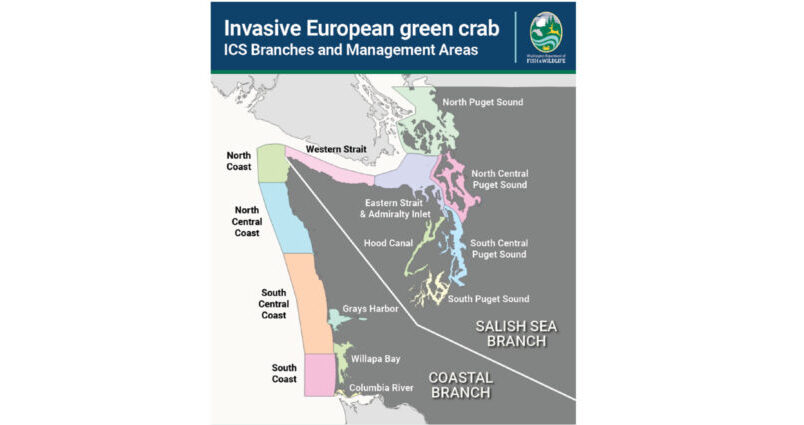
Management Plan. The Washington Department of Fish and Wildlife (WDFW) has created a Coastal Management Branch and a Salish Sea Management Branch to detect and trap European Green Crabs. WDFW reported an estimated total removal of 339,589 EGC through mid-December 2023. WDFW is working with partners in the effort to trap EGC – Conservation Districts, Local Tribes, Shellfish Growers, Washington Sea Grant, Northwest Straits Commission, and volunteers. For more information about the co-managers, tribes, and partners currently involved in EGC trapping or management, visit the European Green Crab Hub; the public can report sightings by using their online form.
Volunteer Opportunities. Washington Sea Grant and Washington State University Extension have teamed up to launch a new volunteer-based early detection program. Volunteers learn how to look for and report the presence of European Green Crab molts. These molts serve as an early indicator of the presence of EGC in an area. For information about future training go to www.wsg.washington.edu/moltsearch or email crabteam@uw.edu to share your interest.
Because native crab species are often misidentified by the public as EGC, WDFW asks that the public photograph and report suspected green crabs at www.wdfw.wa.gov/greencrab and return the crab in question unharmed to the water where it was found. If verified as a European Green Crab, WDFW will follow up with trapping and monitoring.
EGC Traps. WDFW, Washington Sea Grant, and partners, a coalition known as The Crab Team, currently monitor and trap European Green Crab at about 60 different sites. The public is asked not to tamper with EGC traps, which are usually deployed in shallow areas exposed at low tide. Traps are typically identified with a bright orange buoy and an official tag or permit.
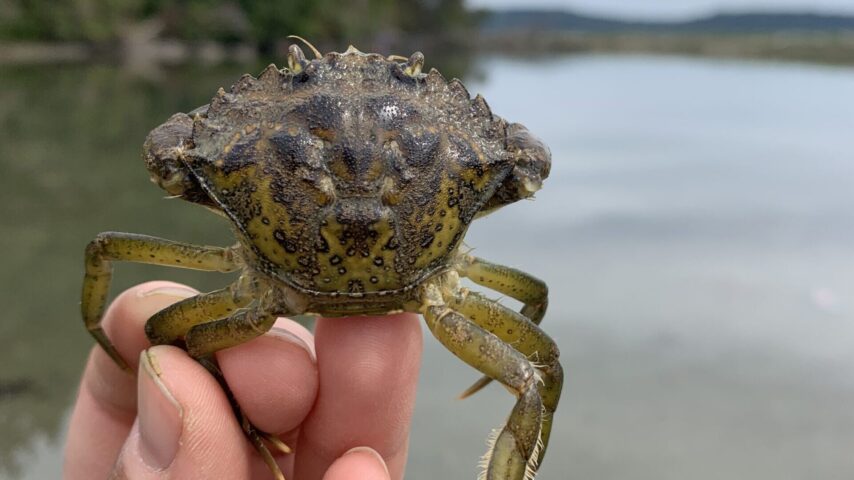
EGC Identification. European green crabs are shore crabs and are found in shallow areas, typically less than 25 feet of water. Look for EGC in estuaries, intertidal zones, and beaches. They are not likely to be caught by shrimpers or crabbers operating in deeper water, but may be found off docks and piers in shallow areas.
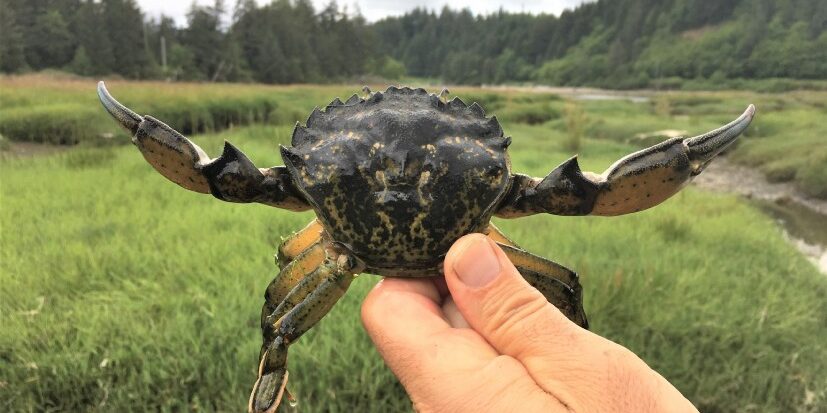
While this invasive crab is predominantly green, it can morph into different colors – brownish, reddish, purplish, and yellowish. Its shell is serrated and pentagon-shaped, with five sharp spines or points on the side of each eye. The back legs are hairy and pointed, while the front claws are larger and each a different size.
WA EGC Sightings. A team from the Coastal Watershed Institute, interns, and volunteers, along with students from Western Washington University, collected adult EGC in the lower Salt Creek estuary, part of the Salt Creek Recreation Area. The site is a popular park in Clallam County on the Strait of Juan de Fuca. Detections were also discovered in similar habitat at McKinley Lagoon in Port Angeles and in Dungeness Bay. Trapping continues in the spring of 2024 in coordination with the county, local tribes, and partners.
Live EGC have been found within Neah Bay, part of the Western Strait Management Area. Local volunteers deployed 60 traps after molts of green crab were found along the shoreline; this rapid response resulted in trapping live EGC. It is believed that EGC settled in the area in 2020-2021. A larger rapid response event is planned to take place in 2024.
EGC have been caught in the Salish Sea, including around Lummi Island and Anacortes, including Padilla Bay where eelgrass is present. EGC is most prevalent in Willapa Bay and Grays Harbor along the Washington Coast.
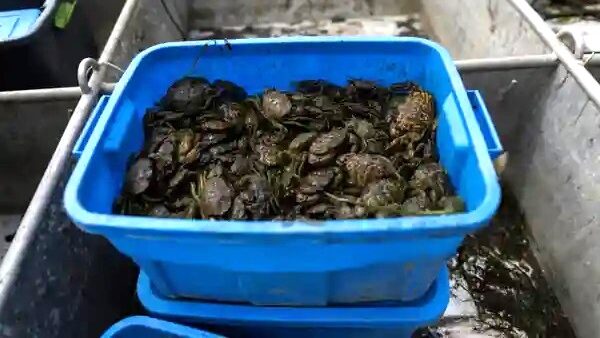
B.C. EGC Sightings. The unique islands of Haida Gwaii have been under attack by EGC with waves of this invasive species. Local resident Bobby Parnell filled two large plastic bins with more than 1,000 European Green Crabs, drawn from a single bay. EGCs were spotted in Haida Gwaii in 2020, and each year the haul from locals shows the speed of invasion. About 30,000 European Green Crabs were pulled from the ocean in 2022 and another 200,000 were trapped prior to the end of 2023 according to Parnell. Local people worry that the battle is underfunded and may be too late.
The European Green Crab also appears to be prevalent around the waters of Greater Vancouver and in Barkley Sound on West Vancouver Island. The Marine Sciences Centre in Bamfield conducted experiments in Barkley Sound to study how EGC affects eelgrass. 18 large cages were deployed throughout an eelgrass bed. The data showed that eelgrass density declined 2.4 to 4 times faster when green crabs were present. It was determined the EGC pull apart plants, and in some cases eat the plants.
Where Do Trapped EGC Go? Most trapped EGC in Washington are frozen (considered most humane) to euthanize the crabs and then sent to WDFW. On the coast where catches are more numerous, EGC are composted and used as fertilizer by local tribes for community gardens. WDFW has partnered with Tidal Grow AgriScience (TGA), an organic fertilizer manufacturer based in Raymond, Washington, which accepts EGC. For EGC caught within the Salish Sea, many are sent to Washington Sea Grant for genetic testing. Testing provides invaluable information about how EGC are spreading and where they are coming from.
Photos: WDFW
Green Crab Hub
Haida Gwaii-Cole Burston