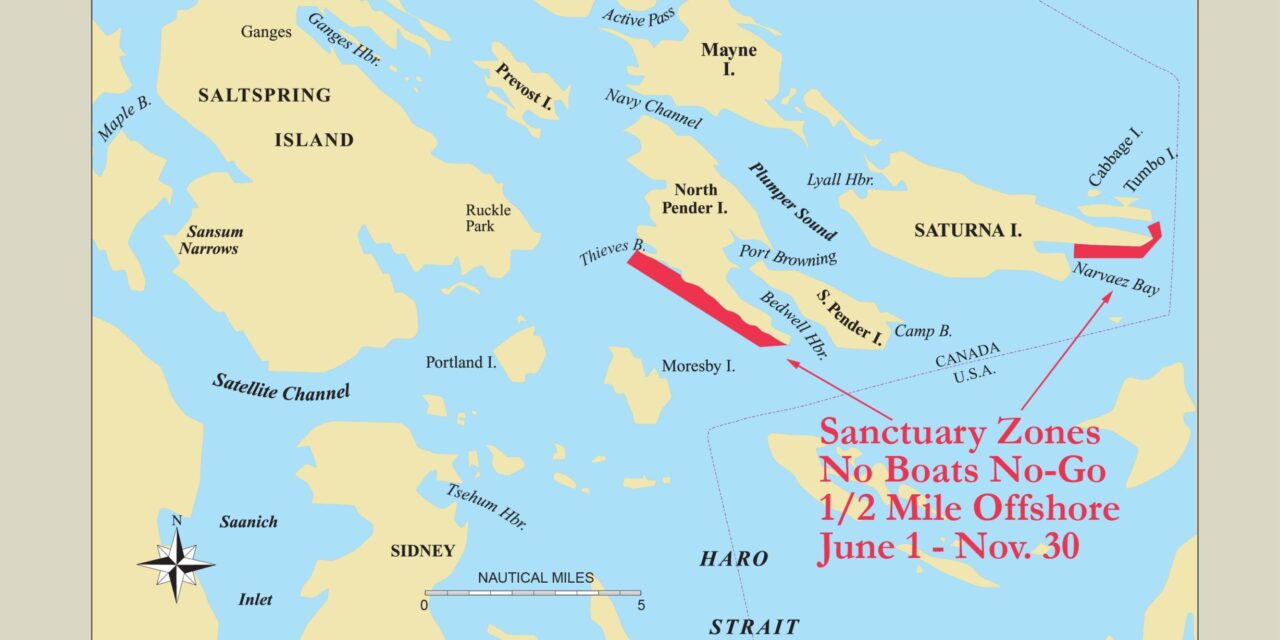
Boaters are reminded to stay outside of the No-Go Sanctuary Zones established in the Gulf Islands to protect Southern Resident killer whales (Orcas). In past seasons a number of boaters received registered letters in the mail from Transport Canada, citing violations and imposing hefty fines for illegally entering these restricted areas.
Two Interim Sanctuary Zones have been established by Government Canada where vessel traffic is prohibited from June 1 through November 30 – the southwest shore of North Pender Island, and the area off the southeast end of Saturna Island. We expect that the Sanctuary Zones will be put in place again for 2024. Both restricted areas are charted and shown on current Canadian charts, but not on U.S. NOAA charts which overlap this border area. The zone off Saturna Island carries a “notation” only. It’s easy to miss these restricted areas on charts. Older charts are missing these restricted areas altogether. Boaters must do their due diligence to avoid accidentally entering zones that are seasonally or permanently closed to vessels.
Government agencies have been using AIS track information to detect incursions and identify offending boats and owners. Communications by the Coast Guard are often heard over VHF Radio warning boaters that they have strayed into a restricted area, but Transport Canada seems to have made it a practice to send registered letters after the fact, threatening fines of up to $250,000, or a summary conviction with not more than a $1,000,000 and/or imprisonment of not more than 18 months. This is serious business and boaters should maintain situational awareness at all times.
AIS serves as a safety feature for communication and collision avoidance with other vessels, so boaters should maintain their transmission of AIS while underway. To avoid being cited, Waggoner recommends using the most up-to-date charts, with all restricted operating areas noted. Posting a reminder of all restricted areas at the helm is also recommended. The Waggoner Guide lists restricted speed zone areas as well as sanctuary zone no-go areas.