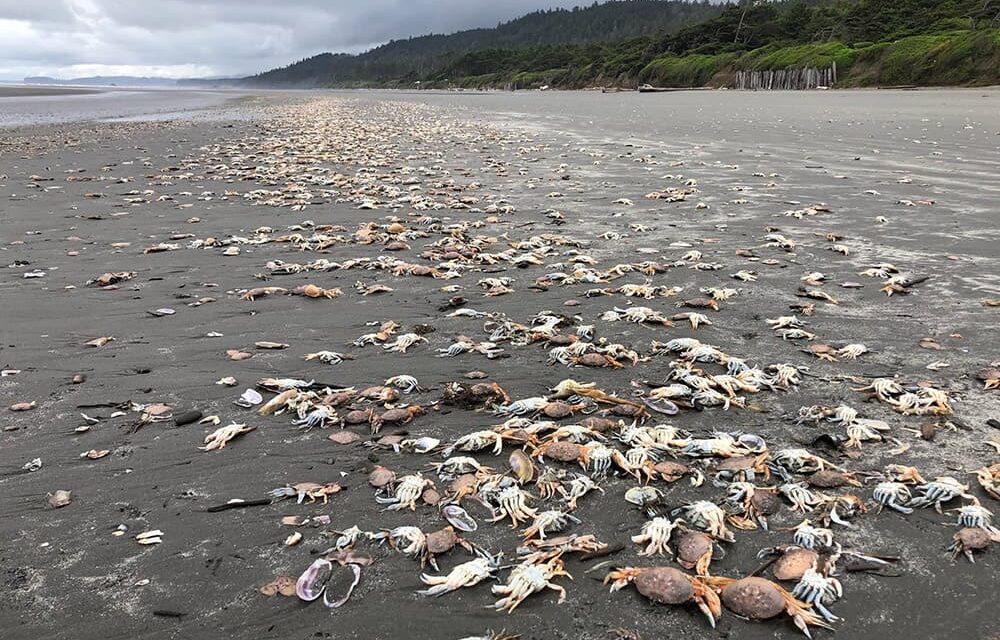
An alarming number of dead Dungeness crab have been documented off the Pacific Northwest Coast, including Northern California, Oregon, and Washington. Dead crab by the hundreds have washed up on beaches and dead crab continue to be found in commercial crab pots, causing considerable concern for the West Coast’s most valuable fishery, and one of the world’s most productive ocean environments.
Hypoxia, dangerously low oxygen levels in the ocean, is one of the main culprits causing crabs and other marine life such as krill, a favorite food of large whales, to die off. While marine animals don’t breathe air, they are dependent on oxygen, which they absorb from the water. If there is not sufficient oxygen in the water column, creatures like crab and krill will perish. Other ocean stressors, including harmful algae blooms, ocean acidification, and rising ocean temperatures, are harmful to the overall health of Dungeness crabs and other creatures. As seawater warms, it holds less oxygen, and as algae dies, microbes break them down, using up more oxygen in the process. The rapid growth of algae can produce toxins dangerous to animals and habitats, and pose risk to humans who eat contaminated shellfish. Blooms of harmful algae have closed entire Dungeness crab fisheries along the West Coast in recent years, threatening the 220 million-dollar US fishery. Jenny Waddell, the research coordinator at NOAA’s Olympic Coast National Marine Sanctuary, says that ocean conditions have worsened in the past two decades. In 2018, the Quinault Indian Nation closed the crab season early because of the effects of hypoxia.
Forecasting when and where a drop in oxygen levels (dead zones) will occur is hampered by a lack of data and lack of mapping. Researchers at Oregon State University have distributed oxygen sensors to volunteers from Oregon’s crab fishing fleet to better understand hypoxia in our ocean. The special instrument/sensor fits inside a crab pot and measures oxygen levels in the water. An attached separate box reads the data, which is transmitted back to scientists at OSU.
In the past, very little data has been gathered regarding the relationships between multiple ocean stressors. A new research project by NOAA (the National Oceanic & Atmospheric Administration) and the Office of National Marine Sanctuaries began in September of 2022 and is projected to be completed in August 2026. Funding in the amount of 4.2 million to support the four-year project came from Federal funds entitled “Understanding multi-stressor impacts on marine ecosystems under climate change.” The research project involves region-wide observations, adapting ocean models to forecast stressor changes, and conducting field and lab studies. State and tribal fisheries managers are collaborating with scientists to keep up with appropriate management responsibilities. NOAA is working in partnership with coastal tribes in Northern California, Oregon, and Washington, along with the commercial Dungeness Crab fishery, and relevant Federal and State agencies to help them ready for future needs and provide recommendations.
The collaborative research is being conducted by NOAA’s NCCOS (National Centers for Coastal Ocean Science) in partnership with the Office of National Marine Sanctuaries led by Francis Chan at Oregon State University and Richard Feely at NOAA’s Pacific Marine Environmental Laboratory. The team consists of 18 scientists at nine institutions:
- Oregon State University
- University of Washington
- Northwest Assoc. of Networked Ocean Observing Systems
- University of Connecticut
- University of California Santa Barbara
- NOAA’s Pacific Marine Environmental Laboratory
- Olympic Coast National Marine Sanctuary
- Northwest Fisheries Science Center
- National Centers for Coastal Ocean Science
Research takes place off the coasts of Northern California, and the coasts of Oregon and Washington, including NOAA’s Olympic Coast National Marine Sanctuary. Sarah Marquis, media coordinator for NOAA’s Office of National Marine Sanctuaries, has emphasized the importance of understanding how multiple stressors interact and cause cascading impacts to a wide range of marine species and habitats; knowledge that is critical for marine resource management.
Photo by Jenny Waddell, NOAA