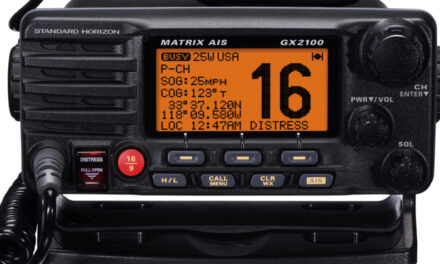
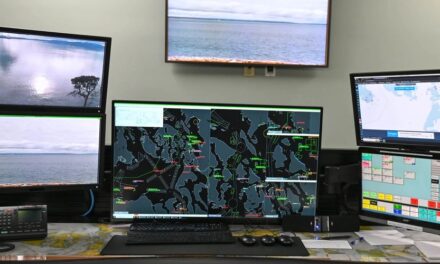
Automatic Identification System (AIS) is a tracking system that uses transceivers on vessels to help captains monitor marine traffic. Vessels with AIS will see a symbol on their chartplotter for every significant ship within radio range that is transmitting an AIS signal. AIS acts like a transponder, operating in the VHF maritime band and is a helpful tool in preventing vessel collisions. AIS transmits a variety of data about the vessel being tracked including:
Static Data
- Vessel’s Name and Call Sign
- MMSI (Maritime Mobile Service Identity), a unique 9-digit number assigned to a vessel that is entered into VHF radios and AIS units used on that vessel
- Type of Vessel and Vessel Size
Dynamic Data
- Position of the Vessel (Lat, Lon)
- Speed Over Ground (SOG)
- Course Over Ground (COG)
- Heading
Travel Data (Class A)
- Navigation Status (engine, sails, at anchor, moored, or restricted maneuverability etc.)
- Current maximum draft
- Port of Destination
- Planned Arrival Time (ETA)
With all this information, you can help prevent traffic conflicts and call any ship with AIS over VHF radio by name, rather than by “ship off my port bow” or some other type of reference.
Types of AIS – Class A is intended for vessels where AIS is mandatory. Class B is intended for recreational vessels and fish boats. Class A transmits more information, more frequently, and at higher power than Class B.
- AIS Class A is required for vessels of 300 gross tonnage and upwards engaged in international voyages and for 500 gross tonnage and upwards not engaged in international voyages, and for commercial passenger ships irrespective of size.
- AIS Class B equipment is not required. Class B units have less functionality than Class A units but operate and communicate with AIS Class A units. The Class B AIS transponder will not transmit unless it has a valid GPS position and a valid MMSI number. Be sure to enter a valid MMSI number and check to see that the dedicated GPS antenna has an unobstructed view of the sky.
- Receive only AIS Units will pick up transmissions from other vessels with AIS but will not transmit any information regarding your own vessel – receive only means you will see other vessels, but you won’t be seen. Receive only AIS units do not need an MMSI.
Programming
All Class B AIS transponders sold in the U.S. are required to be programmed by the dealer who sold the unit to you. Unfortunately, not all dealers take the necessary steps to make sure all of the needed information has been entered correctly. Once your Class B AIS transponder has been programmed, the MMSI cannot be changed except by a dealer; however, you can change other AIS information.
MMSI
It is important to remember that the MMSI (Mobile Maritime Service Identity) number is tied to the vessel, the vessel owner, and country of registry. If any of these change, you need to either apply for a new MMSI or you need to arrange for the existing MMSI to be updated appropriately. When obtaining the MMSI number for the DSC (Digital Selective Calling) radio or AIS unit, the number is provided to the U.S. Coast Guard’s national distress database for use in emergency situations.
Common AIS Programming Errors
- Incorrect MMSI (crucial for emergency assistance)
- Call Sign Discrepancy (call signs are issued by the FCC when you apply for a ship’s radio license and is required for any international travel)
- Vessel Name Discrepancy (the vessel type should not be part of the name; name must match what is on your MMSI issuing document; there should be no prefix like S/V or M/V or F/V
- Vessel Length (stating the correct size matters for safe navigation and avoidance)
- Undefined Ship Type (in high-traffic areas this can lead to hazardous situations)
- Failure of Class A users to update their Navigational Status while anchored or moored
Operation
Mariners should not rely solely on AIS. Mariners should maintain situational awareness at all times, adhere to the rules of the road, and collision avoidance. It is important to keep in mind that an AIS target position shown on your chartplotter shows where the vessel was when the AIS transponder last transmitted a position. Depending upon the boat’s speed, the target will be in a position other than shown on your chartplotter – the target has since advanced/moved. Class A transponders have priority over Class B when transmitting over VHF Ch 70, so Class A target positions are likely to be more accurate. Note that Ch 70 is off limits for voice communications. Additionally, keep in mind that AIS users may not have entered or updated vessel information such as vessel length, like tugs towing barges. The main purpose of AIS is to automatically identify vessels.
The Coast Guard monitors AIS users, watching for any continual failure to maintain accurate information, in which case civil penalties or fines may be assessed. To learn more about AIS and how to obtain, transfer, or update AIS/MMSI information visit www.navcen.uscg.gov/AIS.
How to Check Your AIS Transmission
While underway, go to marinetraffic.com or vesselfinder.com and search for your vessel by name and observe/check the data.