This article is based on ten years of managing without crew on power vessels I have owned over the years – first on two different Ranger Tugs, and since 2018, on my 42-foot Nordic Tug.
No crew to cruise with? Read on!
Safety and Preparation. Cruising without any crew on board (or with guests who are unable perform crew functions) is certainly within the scope of almost any skipper! Here’s how I do it. Safety first! Wear your PFD from the time you are getting ready to pull anchor or leave the dock, until the boat is shut off! Devices are available that will shut off the engine should you fall in.
Do an engine room check to make sure all is in working order before starting the engine; you don’t want to be surprised by an oil or coolant leak while underway. Before departing the dock, check the surrounding area for boat traffic and any debris in the water.
Preparation is key! While underway, keep your mooring lines and fenders tied in place where they are convenient to use. Fenders can be pulled up and stored while underway, and lines tied off to the nearest stanchion or cleat. Lead your bow line back to a midship cleat and tie it off for easy access later without having to go on the bow.
Departing the Dock. When departing the dock, you may find a willing dock neighbor to assist, but don’t count on it. Instead, carefully assess the conditions. Of course, your engine and VHF radio are on. You can untie lines that are loose – keep the tightest lines for last. This method keeps your boat at the dock until you are ready. Keep your fenders in place for now. Once you have untied that last line, step onboard, make your way to the helm, and proceed away from the dock. Pull up and tie off fenders and make the lines fast when you are in a safe place to do so.
Staying Alert. Do you have a long day planned? Have some food ready and handy at the helm, and make sure to include drinks. Remember, only your eyes are on watch, so stay alert. Personally, I like to play an audio book, especially when glassy smooth conditions can make me sleepy! I also keep binoculars close by to check on marine life or double-check approaching traffic.
Now you’re underway, and nature calls! Get your boat into a safe area, carefully check around you for any boats or obstacles, and take the engine out of gear before you take care of business. The same applies to retrieving food or drinks and stowing gear.
Arrival. You have arrived at your destination! Is it a marina? When you contact the marina for your slip assignment, you may want to ask for line help at the dock. Don’t worry if there isn’t anybody to help you in. While still safely away from the dock, unfasten and prepare your lines for easy access. Kick the fenders down (you did leave them in place, right?). My boat has a raised pilothouse, so I keep a Fender Two-Step in place outside the helm door for easy dock access. Bring your boat to the dock, step off (don’t jump!) and secure the boat with the midship line first to keep the boat in place. Next, secure the bow and stern lines. Turn off the engine, you have arrived!
If your destination is an anchorage, there is almost no difference in anchoring alone or with crew. Locate your desired spot, checking the charts for bottom conditions and mark it on your chart plotter, or make note of landmarks. Let off any safety devices on the anchor and deploy it just to the bottom. Slowly back down while laying out the rest of the desired scope. Set the anchor, and mark your location again, also note landmarks. Having these locations marked will help you know if your anchor is secure as the evening progresses.
Weighing Anchor. Pulling the anchor solo does mean more trips back and forth between the bow and the helm. Note the direction of the anchor and remove any anchor bridles or snubbers. Drive very slowly towards the anchoring. You will need to go to the bow periodically to check its position relative to the boat. Remember – the windless is for the anchor, not for pulling the boat to the anchor! Drive over the anchor and start the windless to pull upward. If it’s still fast, move the boat a bit, and repeat!
I’ve never had an anchor stuck on the bottom, but lacking crew members to assist, I do keep an anchor retrieval system rigged to my anchor (it’s designed to give the anchor an additional backward pull in case the anchor is stuck under a rock or other obstacle).
More Tips. Here are a few more considerations for a safe, comfortable cruise:
- Keep your engine and boat maintenance up to date!
- Set up your dinghy/tender so you can deploy it yourself. In my case, on past boats I rigged a 5 to 1 block and tackle to deploy and retrieve my dinghy, but there are many systems available for this purpose.
- Again, make sure you can easily move from the boat to the dock and back. I use the Fender Step from the pilothouse, and additionally, I had a boatyard cut a door in the side of the cockpit for ease of access. For boats with command bridges, there is a trade-off between the great visibility when docking from above, and the easy access to the dock from a lower helm station. This is a personal choice, depending on your own agility!
- Lastly, although I am “crew-less,” I find that boaters, as a group, are very friendly. It’s not uncommon to share a beverage or even dinner with helpful new-found friends at the dock. I once had a dinghy-full of folks invite me to their bonfire and potluck on shore; they even gave me a ride to shore!
- Spend a little time to make sure you and your boat are ready, and enjoy the cruise!
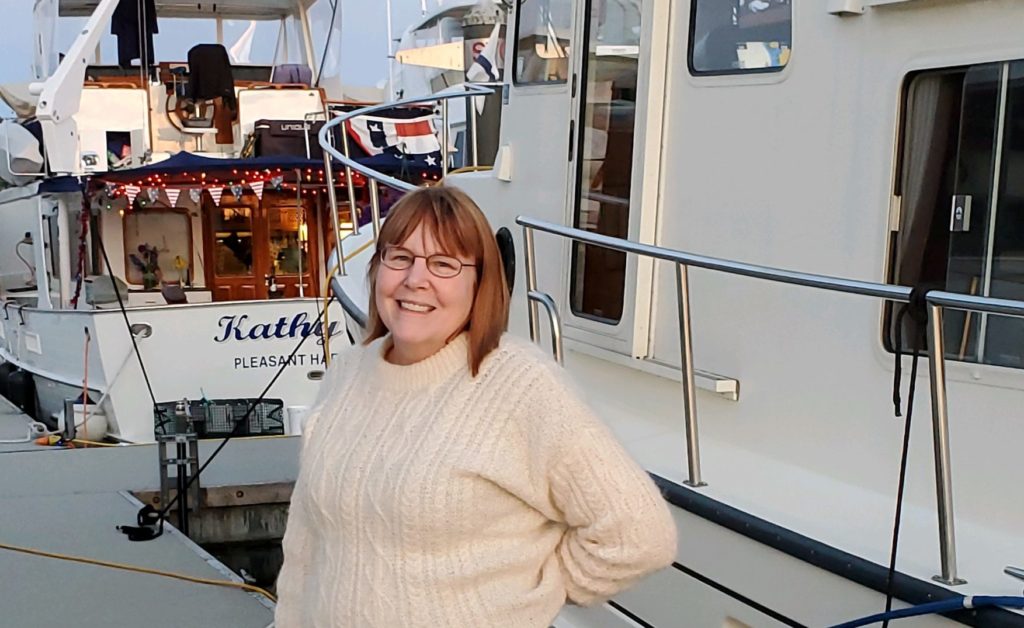
Sue Peterson