The 2022 cruising season marked a huge breakthrough regarding onboard connectivity.
Over the last year, 5G cellular solutions and 5G cell towers in our favorite cruising grounds became widespread, offering a huge leap in data connection speeds and coverage.
As well, the Starlink satellite-based system from SpaceX became a reality and cruisers now have a very viable option for staying connected – even in the most remote anchorages. Starlink is not only a breakthrough for individual boaters, but also indirectly makes remote marina Wi-Fi much more useable. In 2022, several outlying marinas in The Broughtons upgraded their earlier generation satellite-based internet with Starlink, dramatically increasing marina Wi-Fi useability.
While a lot of boaters love the idea of getting away from it all when they go cruising, most of us still want some level of connectivity with the rest of the world. In some cases, boaters want or need to work from the boat while they cruise. In other cases, having access to voice communications, email, web, social media, and streaming is highly desirable. Plus, with so many marine resources such as marina bookings, real time weather and wind forecasts available online, connectivity has become essential for many boaters.
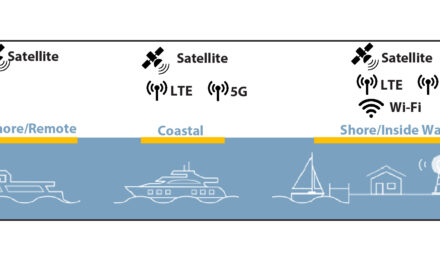
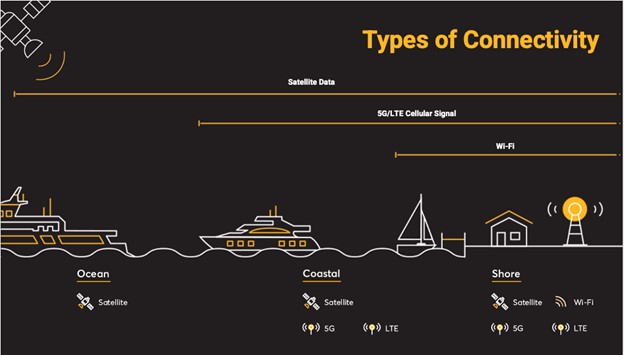
There are three main ways to stay connected while on the boat.
Wi-Fi
Many marinas and coastal towns offer Wi-Fi connectivity for boaters which allows you to connect your computers and other devices to a shore-based hotspot to access the Internet. This solution may work ok, although there are many factors such as equipment quality, bandwidth, and distance from the hotspot that may negatively impact getting a good connection. Vendors such as Wave Wi-Fi and MikroTik have solutions for providing a more functional Wi-Fi connectivity experience, but even these solutions cannot overcome a poorly implemented marina Wi-Fi infrastructure. Plus of course when you leave the marina, your Wi-Fi connection goes away.
5G/LTE Cellular
Virtually everyone owns a cell phone and while making phone calls is the primary use, using the phone for email, web, online apps, or setting it up to be a personal hotspot is very useful when you are on the water.
As you cruise to more remote areas, having a dedicated 4G or 5G cellular-based high-speed router coupled with high-gain antennas helps bring in distant cell signals and provides an onboard Wi-Fi access point to keep all your devices connected. Companies such as Peplink have solutions specifically built for use on boats.
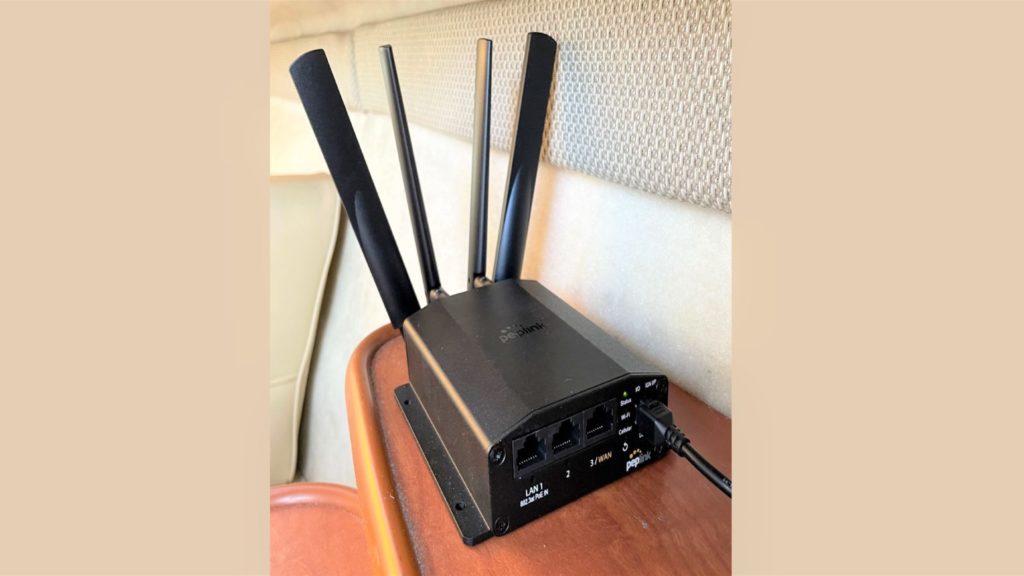
Another option is to install a cell booster from companies such as weBoost, which can amplify your cell phone signal and allow you to boost an unusable cell signal to enough bars to make a phone call. Many boaters in the past have installed both a cell booster for phones and a cellular router for data devices, but with Wi-Fi calling supported on all modern phones and carriers, a good router with a well-placed external antenna can provide coverage for both phone calls and data applications.
These cellular devices require their own cell plan and SIM card. If you go this route, be sure to check with your cell carrier for compatibility with your device as well as things like areas of coverage, data limits, and roaming outside your home region. And since these are cellular based, you typically need to be within 10-20 miles of a cell tower and not behind a mountain in order for this to work well. With good equipment, cellular connectivity is fairly reliable throughout the Salish Sea up to the Desolation Sound area. With fewer cell towers as you go north, or if you are in more isolated areas such as West Coast Vancouver Island, a cellular-based solution will not provide full-time connectivity.
Satellite Connectivity
Marine satellite connectivity solutions from companies such as KVH have been available for years, but these solutions have tended to be quite expensive for both the equipment and the data plans, and data connection speeds are slower than what we are used to. Plus, with a fairly large dome antenna installation requirement, these solutions tend to be only practical on larger power boats. However, since these solutions rely on a signal from satellites, they allow boaters to have some level of connectivity just about anywhere.
The 2022 cruising season marked a huge breakthrough in satellite-based connectivity with the introduction of Starlink from SpaceX. The Starlink solution consists of an external satellite antenna connected to a router with a Wi-Fi access point installed.
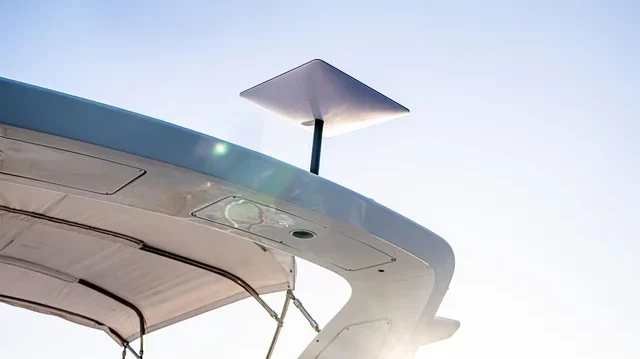
The Starlink equipment and plans are reasonably priced, and it allows boaters to be connected with high-speed, unlimited data throughout our Pacific Northwest cruising grounds and beyond. But Starlink is currently not designed to be used while moving and is not specifically built for use on recreational boats. The current Starlik satellite antenna is not marinized or ruggedized for use in extreme wind and sea conditions so it may need to be stowed while underway. There is no certified network of marine installers for Starlink, so boaters are on their own setting up the antenna and getting it all to work. The higher power draw of a satellite-based system is also a consideration for boaters. But despite those challenges, a lot of boaters deployed a Starlink system during the 2022 cruising season.
Based on reports from cruisers throughout the region, the overall experience has been mixed. Starlink is reported to have worked very well in remote areas of Canada where there was no cell coverage. Others reported that Starlink was not working well in crowded marinas due to obstructions and was sometimes slow in more congested, populated areas. Cellular on the other hand works very well in populated areas and allows boaters to be connected even in extreme conditions while underway. Given all that, a Peplink 5G cellular router plus a Starlink setup has become the go-to solution for a lot of boaters who need full-time connectivity.
This is an exciting time to be a connected boater with the pace of innovation and constant improvements. To keep informed on the latest solutions, we recommend exploring the resources at OnboardWireless.com, SeaBits.com, and other sites such as the Mobile Internet Resource Center.
By Doug Miller, President
Onboard Wireless
Diagram By Peplink