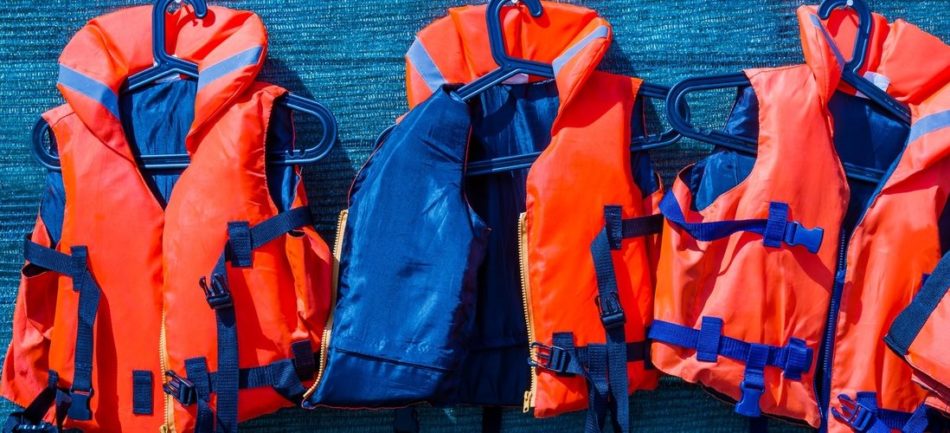
The U.S. Coast Guard and Canada’s PFD regulatory agency, Transport Canada, have joined forces to create an approval system for life jackets that works in both countries. Manufacturers can now meet a single North American standard instead of separate standards for the U.S. and Canada. This new approved system is called “harmonization of personal flotation device (PFD) standards.” The new standard uses icons to identify the performance ratings and usages of life jackets. This new standard does not affect existing Coast Guard approved PFDs, and does not require any action on the part of boaters who have approved PFDs on board.
The biggest difference between legacy PFDs and the new standard is the marking and labeling information provided on the life jacket. Rather than referring to a PFD as Type I, II, III, IV and V with written descriptions, the new standard uses icons to indicate performance rating and the PFD’s intended use. These new PFDs are now appearing in the marketplace, but it will take several years for the old identification system to phase out. You will likely see both labeling systems in stores for several years. Eventually, all new life jackets which are Coast Guard approved will have the new labels/icons.

Going forward, three different types of icons will be found on the label of PFDs:
- Performance Rating Icons – 50, 70, 100, 150 with an image indicating buoyancy. The higher the number, the greater the floatation.
a. Numbers 50 and 70 shows a figure in the water near a dock (calm water, less buoyancy)
b. Number 100 shows a figure in the water near shore with waves (more buoyancy)
c. Number 150 shows a figure in the water off shore with large waves (most buoyancy) - Turning Performance Icons – a curved arrow or half circle, indicating ability to roll a person to a face-up position.
a. Numbers 50 and 70 have a line through the half circle icon indicating that the PFD has no self-turning ability.
b. Number 100 shows a half circle indicating some self-turning ability.
c. Number 150 for offshore waters shows full self-turning ability. - Usage Icons – for which the PFD is not suited. Kayaking, skiing, tubing etc. with lines through the icons means that this particular PFD should not be used for certain water sports. The standard for watersports such as skiing requires three front closures (buckles, zippers etc.).

At the top of the label, the stated weight and chest size will be shown for proper sizing when purchasing your life jacket. Proper fit is an important consideration when selecting a life jacket. Life jackets also need to be Coast Guard approved, and readily accessible on board. Life jackets that are rated lower than 70 are not Coast Guard approved. Boats 16 feet and above are still required to carry a throwable ring PFD.
This new labeling system helps make the selection of PFDs easier and more universally understood in the U.S., Canada, and Europe.
In the old system, Type I was for commercial use and had the most buoyancy; Type II PFDs were inexpensive yoke style; Type III were vests that were more comfortable, but had low buoyancy; Type IV were throwable devices; and Type V were others that didn’t fit in these definitions. Then inflatable life jackets came along, adding to the mixed messaging regarding PFDs. The intent of the new labeling standard is to help users select the correct life jacket for the intended activity.