Did you know that ancient glass sponge reefs are located in the northern and southern waters of British Columbia? In 1987, a team of scientists discovered living glass sponge reefs in Northern BC; and in 2001, several smaller reefs were discovered in the Strait of Georgia and Howe Sound of Southern BC. Prior to these discoveries, glass sponge reefs were thought to have gone extinct with the dinosaurs 40 million years ago.
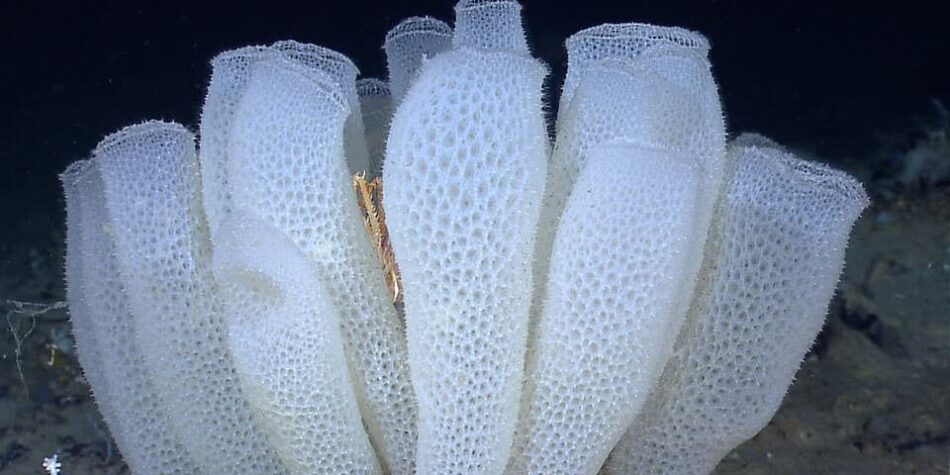
How Sponge Reefs Grow. While individual glass sponges have been found around the World, it seems that these sponges have only built reefs in British Columbia and Alaska. These living glass sponges grow on top of each other and fuse together to form complex structures. The sponge skeletons are made of silica formed into delicate needle-like structures called “spicules.” Glass sponges also fuse the point on the spicules together, like scaffolding, to create a lattice-like structure. The skeleton is further strengthened as they grow and touch other glass sponges gaining support, resulting in some reefs reaching heights of up to 20m (around 66 feet). Sponges, however, grow very slowly (one to nine centimeters per year) and need an amazing amount of silica in order to build. There are three species of glass sponges in Hecate Strait able to build reefs. In the Strait of Georgia, the reefs are formed by two species of glass sponges and reach up to 14m in height, covering one to five square kilometers.
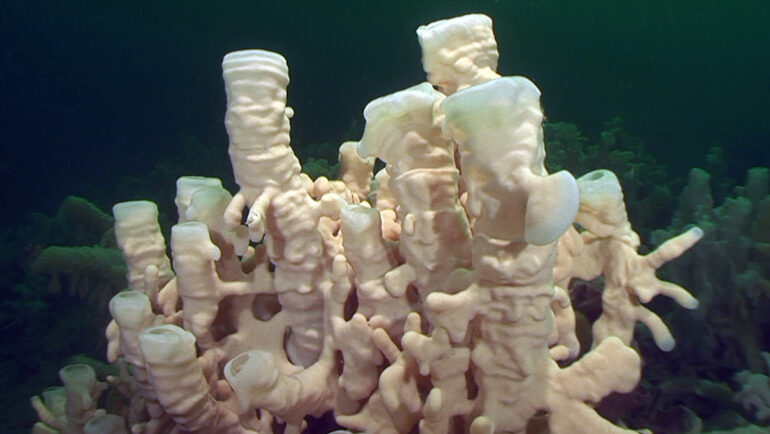
Shelter for other Species. Because glass sponge reefs in Hecate Strait span hundreds of kilometers, the reefs are able to support entire communities of other marine species. The reefs act as a nursery for many small fish, baby rockfish, herring, and spot prawns, which also attract halibut.
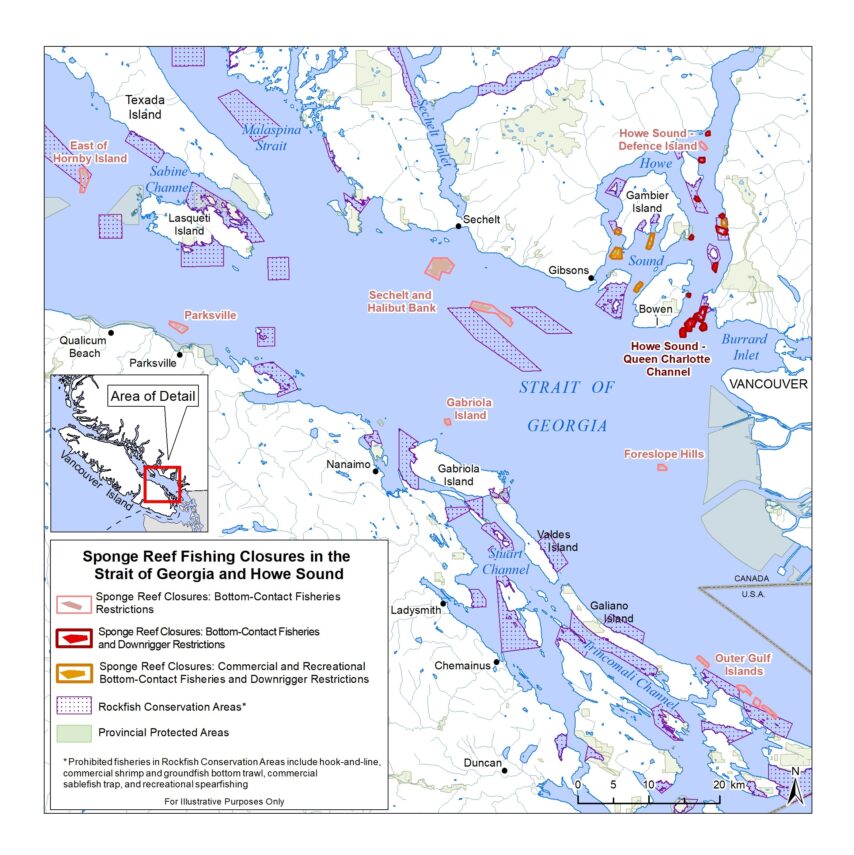
The fragile reefs made of silica (glass) can be easily damaged, so Conservation Areas were established around the glass sponge reefs of Howe Sound and the Strait of Georgia in 2015. Bottom fishing is prohibited around the nine reefs, in addition to no crab, prawn, and fish traps, trawling, and groundfish by hook and line (including halibut). For coordinates of the closures, visit Canada.ca/glass-sponge-closures. The fishing closures apply to all recreational, commercial, and First Nation food fisheries.
Sponge Life and Reproduction. Sponges are found in deep-sea habitats and live by consuming small bacteria and plankton that’s filtered from the water. Their bodies have thousands of tiny holes or pores, through which water constantly flows in order to absorb food, oxygen, and silica. Glass sponges are very efficient filter feeders. One small reef, only a kilometer in length, in the Strait of Georgia can filter 80,000 liters a second, the equivalent of an Olympic sized swimming pool in less than a minute. Because sponges are such prolific feeders, they are also able to process vast amounts of carbon, which helps to move nutrients from the top of the water column to the bottom.
Glass sponges reproduce by releasing tiny, swimming larvae into the water column, which then settle on a suitable surface, where they can grow into a small replica of the adult. Most glass sponges reproduce sexually (male and female germ cells), although asexual reproduction may also occur (cells on the side or base of the parent begin to bulge out).
Next time you’re boating in the Strait of Georgia or Howe Sound, think about the beautiful glass sponges that lie beneath. Boaters can help prevent accidental damage to these unique glass sponge reefs by avoiding anchoring within the Glass Sponge Conservation Areas.
Photos: NOAA and Neil McDaniel
Maps: Fisheries and Oceans BC
Canadian Parks And Wilderness Society (CPAWS)