Nearly 150 years ago, the wooden-hulled sidewheel steamer sank off Washington State near Cape Flattery and is considered one of the deadliest maritime disasters in the Pacific Northwest. The S.S. Pacific was the first ship carrying passengers on a regular scheduled service between Victoria/Seattle and San Francisco. The wreckage of the vessel was just recently located by Jeff Hummel, Director of the Seattle-based non-profit company Northwest Shipwreck Alliance and President of Rockfish Inc.
The Sinking. In November of 1875, the 223-foot steamer S.S. Pacific departed Esquimalt Harbour from Greater Victoria British Columbia in poor weather with 52 crew (led by Captain Howell), 35 passengers from Puget Sound ports on board, and another 132 passengers with tickets embarked at Victoria, and an unknown number of persons that rushed aboard without tickets; children sailed for free so were not among those counted. Passengers included prominent Victorians, wealthy businessmen, gold miners, and 41 unidentified Chinese.
The ship’s cargo included 300 bales of hops, 2,000 sacks of oats, 250 hides, 11 casks of furs, 31 barrels of cranberries, 2 cases of opium, six horses and 2 buggies, 280 tons of coal from Puget Sound, 30 tons of miscellaneous goods, and $79,220 in gold worth $10 million today.
On November 4, 1875 at approximately 10 p.m., the S.S. Pacific collided with a sailing vessel, the Orpheus about 25 miles southwest of Cape Flattery. The vessel Orpheus was on its way north from San Francisco to pick up coal at Nanaimo. After the collision, Orpheus readied their life boats and made repairs, unaware that the S.S. Pacific had sunk. Prior that evening, the S.S. Pacific had difficulty remaining on an even keel, and the crew had filled life boats with water to help correct her list.
Out of the estimated 325 people on board the S.S. Pacific, only two people survived, Neil Hanley the ship’s quartermaster, and Henry Jelly of Ontario. They had managed to climb onto floating broken parts of the ship. Jelly was rescued 2 days later by the vessel Messenger and taken to Port Townsend, the first indication that the S.S. Pacific had sank. He reported that the S.S. Pacific broke in two and the ship’s smoke stack fell on the capsized boat. A number of vessels were sent to look for survivors; Henley was rescued 4 days after the sinking by the vessel Wolcott.
Wreckage Discovered. Jeff Hummel created the salvage company called Rockfish Inc. for the sole purpose of finding and recovering the S.S. Pacific and formed the Northwest Shipwreck Alliance (NSA) to bridge the gap between historical organizations/museums and the technology and expertise required to discover and preserve shipwreck artifacts. After years of searching for the S.S. Pacific, which began in 1993, Hummel finally met with success.
Hummel discovered a significant clue after interviewing dozens of commercial fishermen – fortunately a commercial fisherman had brought up some old coal in a fishing net. The coal was chemically analyzed by a laboratory, and it was found to be a match of that used by the S.S. Pacific. With this clue and by consulting historical records and calculating wind and currents, Hummel was able to narrow the search area. The wreckage was found approximately 23 miles offshore scattered across a slope about 1,000 to 3,000 feet deep. Hummel’s team found two circle depressions that turned out to be the distinctive paddle wheels from the Pacific several hundred yards from the actual wreck. The upper deck of the S.S. Pacific was later identified by low resolution sonar imagery. The state of preservation of the wreck is said to be quite good.
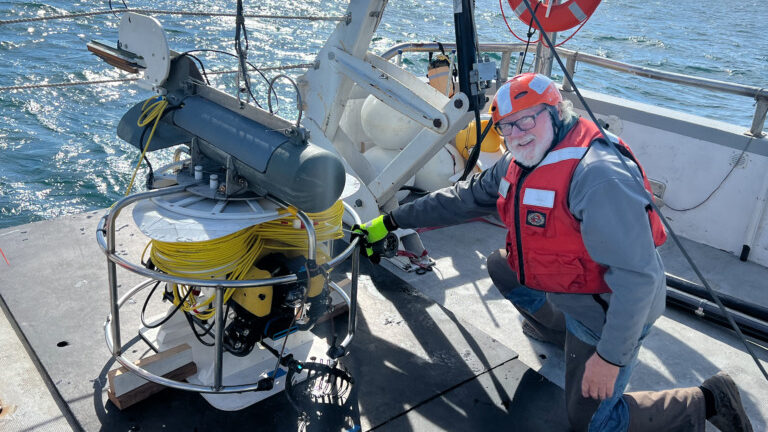
Around the same time, the U.S. District Federal Court granted Rockfish Inc. the exclusive rights to salvage the ship. Hummel’s team plans to salvage whatever they can and hope to begin the recovery process in the fall of 2023. Salvage and preservation efforts are expected to take several years. The ultimate goal is to create a museum to house the artifacts and tell the complete story of the S.S. Pacific, including the people on board.
The Rest of the Story. Exclusive salvage rights allow Rockfish Inc. to recover whatever they can; but if members of the public can prove a connection to what’s salvaged, they can file a claim to repossess it. Hummel says that four people have contacted him claiming to be descendants of passengers on board, and he hopes that others will come forward – “that’s the exciting part of the story,” he says.
As for the sailing vessel Orphesus, it was known that she crossed the path of the S.S. Pacific; however, faults were found with both vessels/captains. Captain Sawyer of the Orphesus was vilified in the press and arrested, but an inquest in San Francisco exonerated him. Captain Sawyer died at Port Townsend in 1894.
Photos: Rockfish Inc.