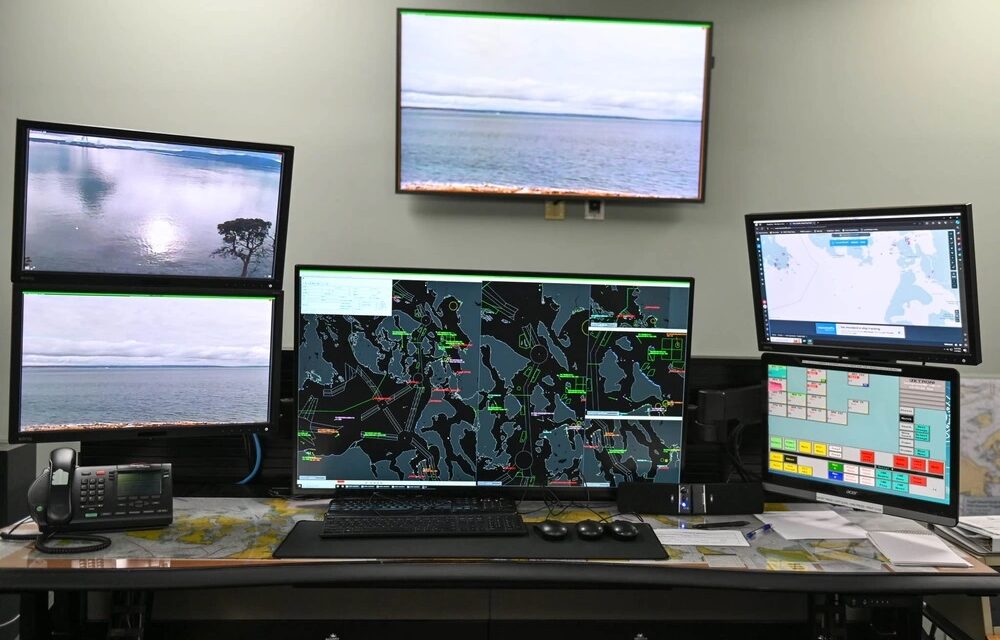
As boaters prepare for the cruising season, mariners are reminded that the U.S. Coast Guard Sector Puget Sound has introduced a cetacean desk pilot program. The Coast Guard announced that the goal of the four-year program, hosted by the Puget Sound Vessel Traffic Service (VTS), is to mitigate adverse impacts of maritime vessel traffic on endangered and threatened large cetaceans (whales) in the Salish Sea.
The announcement stipulated that the pilot program will collect reports of whale sightings from mariners in the Vessel Traffic System with real-time data about the location of the whales through the Whale Report Alert System (WRAS). The program aims to reduce ship strikes and whale disturbances and allow ship operators to slow down preemptively. Sightings of whales called in by mariners to the VTS will help vessels make appropriate decisions. Underwater listening devices that determine the location of whales will send alerts to commercial vessels and ferries. Senator Maria Cantwell, author of the legislation to establish the program, said that “the whale desk will operate 24 hours a day, seven days a week.”
According to the Coast Guard, nearly 300,000 vessels (not including private boats) transited the Salish Sea in 2023, ranging from container and cargo ships to cruise ships and ferries. While the Salish Sea has a rich diversity of whale species, the area also sees a lot of commercial traffic. Boaters who spot whales can use the Whale Report app that will feed into the Coast Guard’s Puget Sound Vessel Traffic Service. The Whale Report app is available on Apple or Google. Alternatively, boaters may phone the U.S. Coast Guard Cetacean Desk at 206-217-ORCA (x6722) to report the species of whale sighted, the number of whales, and the direction of travel. Boaters may also contact the Puget Sound VTS designated traffic channels, 5A and 14, to report whale sightings.
The Puget Sound VTS Whale Desk is similar to that of the Canadian Coast Guard’s Marine Mammal Desk established in 2020. Their program incorporates sightings from individuals’ apps and other sources such as tracking of whale watching boats, sightings from light stations, and aircraft operated by Fisheries and Oceans Canada. You can contact the Canadian Coast Guard Marine Mammal Desk at 833-339-1020.
Studies have been underway in both Canada and Washington State, testing land-based thermal cameras to spot whales at night by detecting warmth in the waters. Thermal imaging cameras have also been installed and tested with British Columbia Ferry Services, Inc. in the Gulf Islands where there are a number of narrow passages. The cameras are linked to a computer that is programmed to know the difference between a vessel vs a whale; however, dense fog and rainfall can impair camera accuracy. Fortunately, acoustic monitoring is already being used in the narrow waterways of British Columbia.