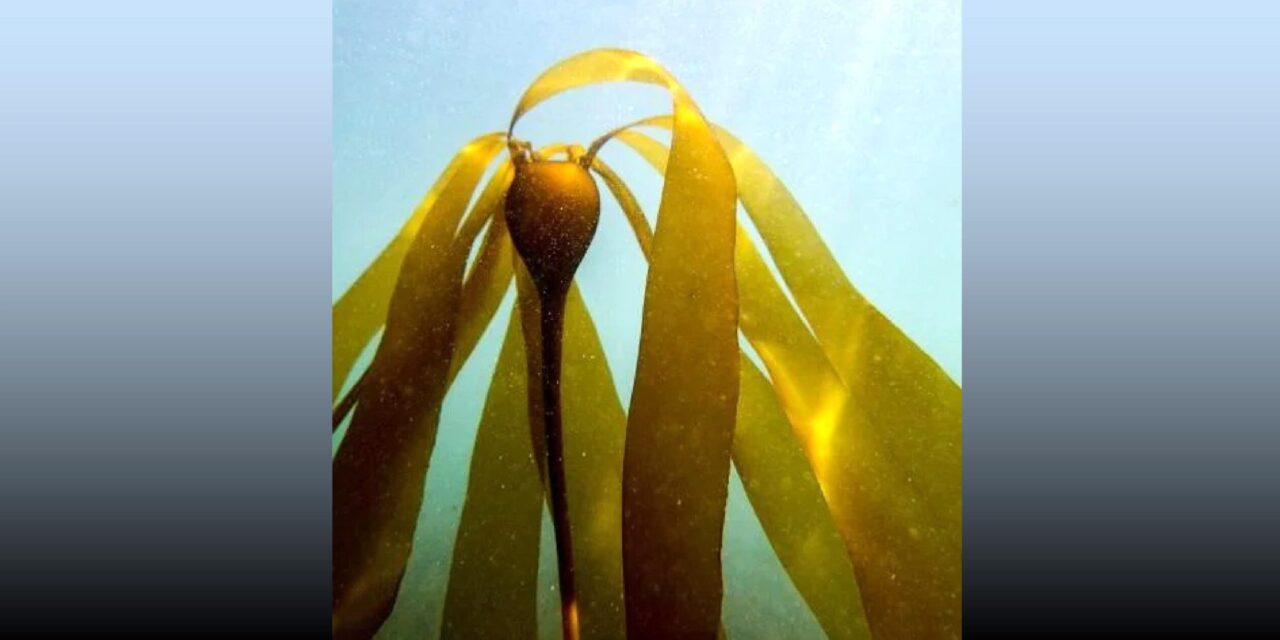
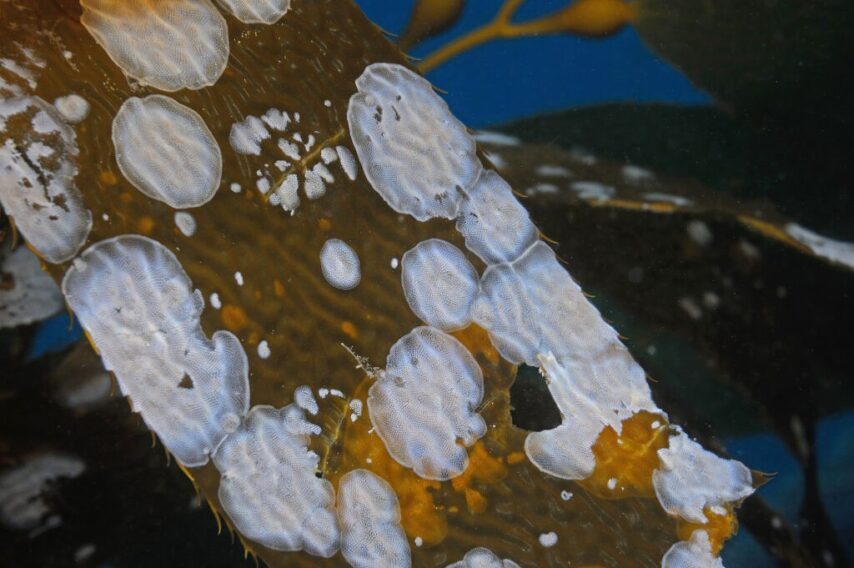
Have you ever wondered what those white spots are on the blades of bull kelp? The circular patterns of white seen on bull kelp blades in the spring and summer are actually tiny organisms that feed and grow on kelp. These invasive species, covering large areas of the kelp, cause the blades to become brittle and break, especially during storms, leading to significant reductions in kelp forest density.
These small invertebrates, or bryozoans, expand from one individual to a colony of thousands that can encrust an entire kelp blade. The tiny larval bryozoan is a clam-like swimmer in a shell that opens like an umbrella and parachutes down onto a clean kelp blade, cementing itself with a sticky glue. Once established on the kelp, the settler begins to multiply, reducing the surface area available for photosynthesis and restricting the absorption of nutrients.
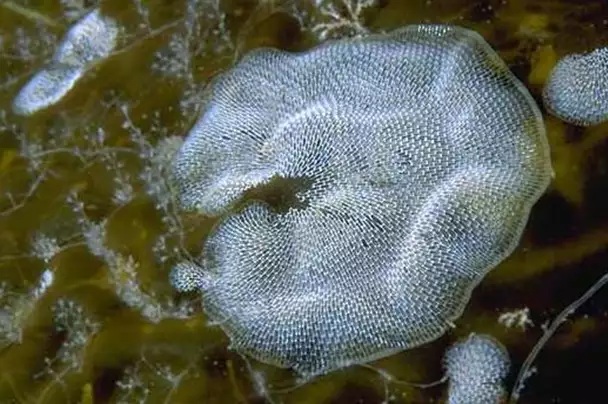
Research suggests that warmer ocean temperatures are leading to increased growth of these bryozoans, which in turn reduce kelp forests and overall habitat for other marine life. These creatures grow quickly by cloning identical individuals into a circular crusty colony. If a piece of a bryozoan colony breaks off, the piece can continue to grow and form a new colony.
These are fascinating creates to study and the research of bryozoans is a relatively new study among scientists. The crew of s/v One Ocean, with scientist Grace Dalton, are adding to this interesting research. Data collected by s/v One Ocean will be further analyzed by the University of Victoria in BC and the University of Washington. You can watch some interesting videos of kelp forests taken by Grace Dalton HERE along with a tour of the vessel One Ocean. The kelp videos were hosted on the international educational program “By the Seat of Your Pants.”
While bryozoans can damage kelp forests, they can be beneficial as a food source for some marine invertebrates. Some biochemical scientists suggest that bryozoans may even have some medicinal use. Mother Nature seems to have her checks and balances – sea slugs, snails, sea spiders, crabs, and crayfish all eat bryozoans, as do sea urchins, which also feed on kelp, but scientists have seen an increase in bryozoans and an increase in sea urchins devouring kelp forests of late.
As noted by Grace, kelp forests are among Earth’s most productive marine ecosystems and play a critical role in the marine carbon cycle and support immense biodiversity. As s/v One Ocean approaches the sub-Antarctic waters, they continue their intensive research on two keystone species: Bull Kelp (mapping resilience and growth) and Giant Kelp (studying carbon sequestration). To learn more about the travels and research by sailing vessel One Ocean, go to www.oneislandoneoceancom
Kelp Photo: Grace Dalton
Bryozoan Photo: Monterey Aquarium
Bryozoans Photo: Oregon Coast Aquarium