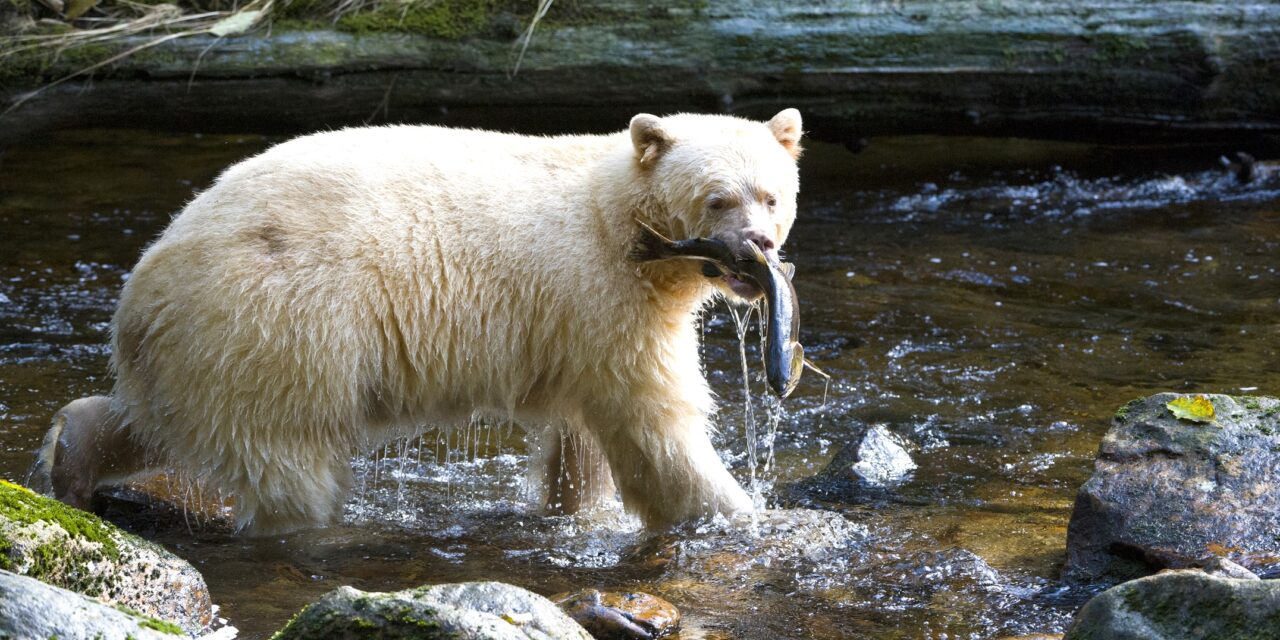
Who doesn’t love seeing bears in their natural habitat? Boaters are among the lucky few who can observe bears on land from the safety and distance of their vessel. Vessels maintaining the appropriate distance also help ensure that bears won’t be displaced from their established habitat or territory.
In the 2024 Waggoner Cruising Guide, you will find a complete list of official bear-viewing sites. Some of these sites require permits, while other sites provide viewing guidelines without a needed permit. If you happen to see a Kermode bear, often called a ‘spirit bear’ because of its white coat, consider yourself lucky! There are less than 400 of these rare bears, with the largest numbers found in the Great Bear Rainforest, the region around Butedale and Hartley Bay in British Columbia.
The Great Bear Rainforest, consisting of 6.4 million hectares, extends from the Discovery Islands in the south portion, northward to the BC-Alaska border and the offshore islands within this range except Vancouver Island and Haida Gwaii. Its northern end extends up Portland Canal to the vicinity of Stewart. Its southern region includes many inlets, channels, canals, and the Fiordland Conservancy.
The Kermode bear is a subspecies of the American black bear, and this white variant spirit bear holds a prominent place in the oral traditions of indigenous peoples of British Columbia. The white coloring is the result of a recessive mutant gene; bears with two copies of this gene appear white, while bears with one copy or no copies appear black. Kermode bears are omnivorous for most of the year, subsisting mainly on vegetation and berries. During the autumn salmon migrations, they become predators along streams and rivers. Thanks to their white fur which is not easily detected by fish, Kermode bears are quite successful at catching fish.
Male Kermode bears can reach 496 lbs. (225 kg) or more. Females are much smaller, with a maximum weight of 298 lbs. (135 kg). The Kermode bear was named after Frank Kermode, former director of the Royal B.C. Museum, who researched the subspecies. The name of the bear is pronounced ker-moh-dee, differing from the pronunciation of the Kermode surname.
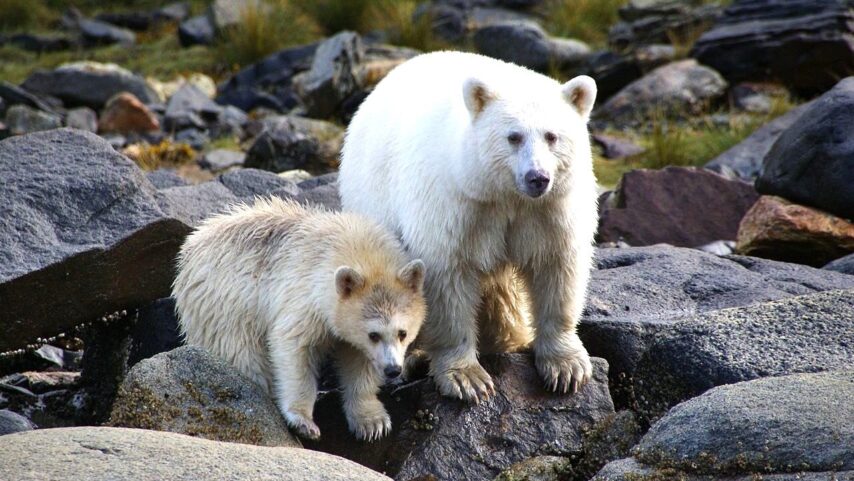
Kermode Bear Sightings. This white variant of the Black Bear is most common on three islands in British Columbia: Gribbell, Princess Royal, and Roderick, where they make up 10-20% of the Kermode population. The largest concentration of the spirit bear is reported to be on Gribbell Island, consisting of 80-square-miles. The island is within in the territory of the Gitga’at people, who inhabit the village of Hartley Bay.
You can join Marven Robinson, spirit bear guide, and Tim Irvin, Ecologist, for a cultural, wildlife tour designed for couples or small groups. Your guides cannot promise to find a spirit bear but can promise an adventure. Tours are booked throughout September and fill up a year in advance, see www.timirvin.com or call (613) 915-8083 to learn more.
You can also look for spirit bears that have been sighted along the shores of Prince Royal Island near the old cannery site of Butedale. If you’re feeling lucky, hang out near the falls and watch along the shores for a chance to see a spirit bear.
Another option is to vacation at the impressive Spirit Bear Lodge, an ecolodge at the Native village of Klemtu. Enjoy the accommodations and take in their all-inclusive multi-day adventures. Tours offer exclusive access to wildlife viewing areas and cultural sites within the Kitasoo Traditional Territory. See www.spiritbear.com or phone (250) 339-5644 for more information.
If you absolutely must see a Kermode bear, visit the British Columbia Wildlife Park in Kamloops, BC. Kamloops is reached by car from Vancouver, BC traveling east on highway 1, then northeast on highway 5. At this wildlife park, you can visit Clover, a Kermode bear who was rescued as an abandoned yearling cub. After two unsuccessful attempts to rehabilitate him and release him back into the wild, he was sent to the park in 2012 where he still resides. Visitors will see many other animals at the park, learn about their stories, and learn about conservation through education.
Sponsor a Bear Cam. You can see all the wildlife action and support the Spirit Bear Research Foundation by sponsoring a bear research camera in Kitasoo/Xai’xais territory. With a minimum donation of $400 – the cost of one remote camera – they will send you photos or videos throughout the research season of the animals detected by the camera you have donated. Maybe your camera will get visited by a grizzly, black, or even a spirit bear! You’ll see other forest animals too. Visit the Foundation’s website for more information.
Photo: BBC Wildlife
Bear & Cub by Maximilian Helm
Spirit Bear Lodge