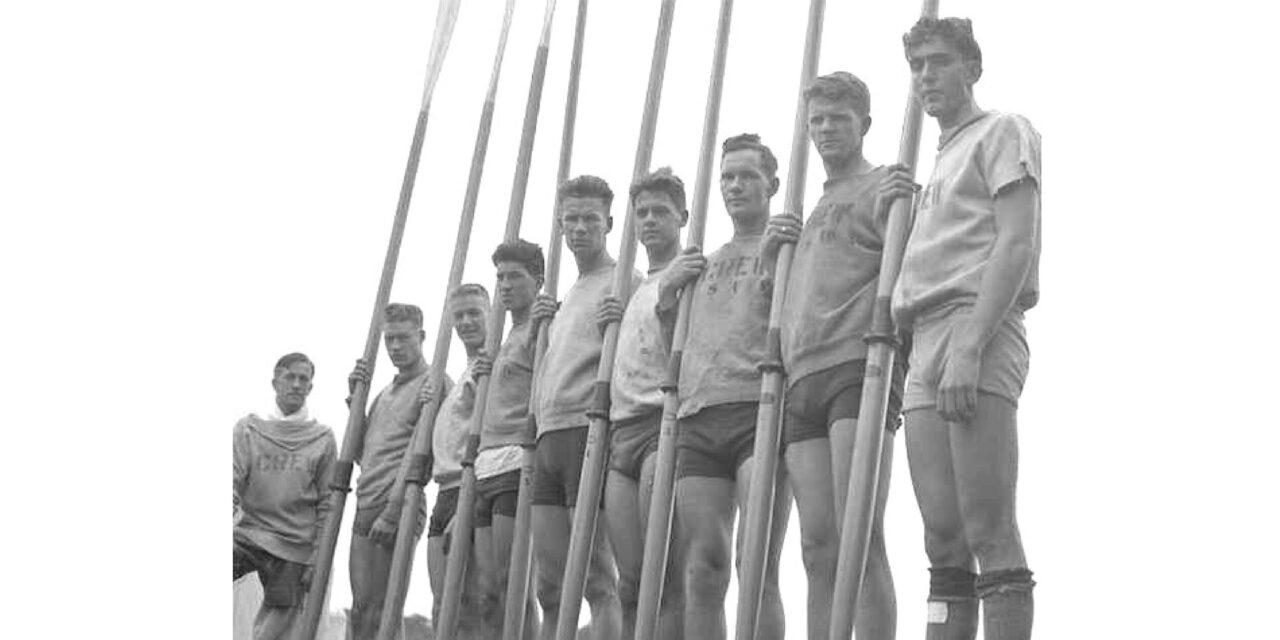
University of Washington historian, Eric Cohen, has put together a panel knowledgeable in the sport of rowing for a special presentation at the Seattle Boat Show on Sunday, February 4, starting at 1 pm. Together, the panel will provide fascinating insights into the history of UW rowing and the connection with the recent movie and book of the same title, “The Boys in The Boat.” Tickets ($20) to attend this special panel presentation can be purchased thru the Seattle Boat Show website, along with your entrance ticket to the Boat Show.
We recommend reading “The Boys in The Boat,” written by Daniel James Brown, which will inspire and prompt questions in preparation for the boat show’s guest panelists. The author of the book delves into the character of the boys on the team who won the 1936 Olympics in Berlin, Germany, which shocked the world and Adolf Hitler. The author also brings to light the character of head coach Al Ulbrickson, Tom Bolles the freshman coach, and George Pocock, who built racing shells in the loft of the University’s shell house. Brown describes the many hard-fought races and the challenges leading up to the 1936 Olympics.
This true story is of particular interest to those who grew up in Washington State and those who love history. America was in the throes of the Great Depression, and many members of the UW rowing team(s) competed because they couldn’t afford their college fees. Their upbringing as farm boys, fishermen, and loggers made them physically strong, but they would have to meet the intellectual challenges of the sport as well.
Both the book and the movie center the story around Joe Rantz, whose mother died when he was very young. His father remarried and had other children. Keeping everyone fed on a limited budget was hard. Joe was sent away at the age of 10 to live elsewhere. His father later was able to put a downpayment on an auto shop in Sequim where he moved his family, including Joe, to an apartment in Sequim and later to a half-finished farm house.
With more mouths to feed, Joe’s stepmother became more irritated with Joe, now in his teens, and with his teenage friends. One day Joe came home from school to find his father, along with his wife and children, packed in the car with suitcases. Once again, Joe was abandoned to fend for himself. “We can’t make it here” his father said, “you’re pretty much all grown up now anyway.” It is through those lessons of ‘hard knocks’ that Joe eventually finds success in his life and harmony with his team mates – a team that learned to trust one another and row in unison, and as one with the boat.
To learn more about rowing shells and the challenges of competitive rowing, be sure to attend the panel of experts on February 4th at the Seattle Boat Show. The panel is made up of Kirk Knapp, owner of Conny (the 1936 coaches’ boat); Melanie Barstow, shell house tour founder; John Tytus, president of Pocock Racing Shells; and Yaz Farooq, Olympian and UW women’s head coach. Don’t forget to stop by the Antique and Classic Boat Society’s booth (East Hall #1400) to see the Conny rowing shell that was featured in the movie.
Corbis Photo