Boaters often invite guests or family members to ride along on a segment of their summer cruise. In addition to planning meals, destinations, and shoreside activities, it’s imperative that the crew know where to find the onboard safety equipment and how to use the radio in case of an emergency.
Equipment Know How. The crew should know where to find life jackets, fire extinguishers, and flares or emergency signals. Does your crew know what to do in a man overboard situation? Do they know where the EPIRB (emergency position-indicating radio beacon) is located? How to launch the dinghy? Or use the radio? Don’t forget to provide instruction on how to safely use the stove, and properly use the head and shower. You will want to show your crew where to hang the fenders and tie off lines before coming into a dock or moorage slip. Learning boat terminology and procedures can be fun for everyone and helps set that adventuresome team spirit.
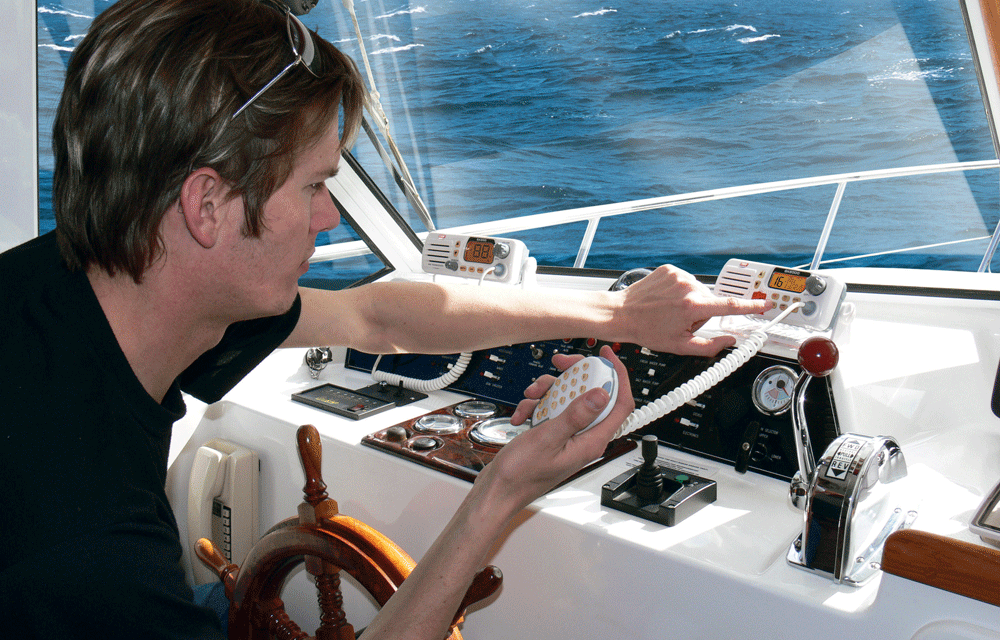
Communications. Instruct your crew how to make a distress call on the VHF Radio and what information to provide the Coast Guard – does your crew know where to find and read your GPS position (lat/lon location)? Able to describe the emergency and describe your vessel? Be sure they know how to use the radio for both talking, listening, and changing channels as directed. Your crew should also understand the following Distress Calls:
- MayDay – the codeword repeated three times alerts the Coast Guard and other boats in the area that you have a life-threatening situation and need immediate assistance. Examples include a boat that is taking on water, a fire on board, or someone with hypothermia needing immediate medical attention.
- Pan Pan – is used when the safety of the ship or person is in jeopardy but is not life threatening, such as having gone aground or the loss of power, but no threat to life.
- Securite’ – is used to transmit information about the safety of navigation or a navigational warning. Examples include a large commercial vessel coming through a narrow channel, or boats rounding a blind corner, or a missing channel marker.
Ship to Ship VHF Channels. The initial contact between vessels is usually made on Channel 16, and then captains switch to an agreed upon “working channel.” Vessel working channels for communication between recreational vessels include Channels 72, 69, and 68 for both Washington/Alaska marine waters and the waters of British Columbia. Other channels are specific for B.C. waters and Washington/Alaska waters. There are also channels for commercial and port operations only. When boating near Vessel Traffic Lanes, it’s a good idea to have a second radio tuned to a designated Vessel Traffic Service channel for that specific area.
Official government agencies manage the different VHF Radio frequencies (channels) and designate the purpose or usage for these channels. The diagram found on page 39 of the 2024 Waggoner Cruising Guide shows the various VHF channels used in Pacific Northwest Waters.