Is there a more perplexing issue than fuel management facing a new boat skipper with a diesel engine?
From an early age we learn about gasoline going into cars at the gas station. Filler up, jump in the car, turn the key… vroom, off we go.
Likewise, on a boat, we jump on board. There is a key. We turn the key. A dock mate shouts, check the filter for water, your fluid levels, blah blah blah. . . You got this. Besides, didn’t Captain Ron say, “If anything is going to happen, it’s going to happen out there!”
At the wheel, the wind in your hair, perhaps a crew mate enjoying the sun/wind/freedom. Then, SPUTTER, cough, cough, silence. That is not a good sign, what happened?
The first time you experience fuel starvation can be scary. Combating dirty fuel led me to a word search “fuel polishing”. This search produced 1400 plus threads by boat owners. I bought my ‘bigger’ boat in 2015. Since my first fuel starvation experience, I have looked for an elegant method to keep my boat fuel clean.
I explored several solutions.
Chemicals, pumps, filters, hoses, services, even buying a pump/filter that sits on the dock sucking fuel from the tank. All of them offered solutions. All were elements of a system I envisioned, but neither simple nor integrated.
None offered an early warning system. They involved multiple operations that required time and experience to maintain. When the engine stops, there is the need to identify the problem, design a solution, do it with the parts on the boat.
Here’s what makes up our fuel systems in the marine environment.
Exploring Basics:
Diesel engines are relatively simple. They need few elements to keep them running.
- A combustion chamber to house the controlled explosion
- A cooling system to protect the engine
- An exhaust system to expel the combusted gasses
- Air to provide oxygen for combustion.
- A source of clean fuel.
The fuel system is our focus. It is generally comprised of:
- Fuel access to load fuel on board.
- Fuel storage tanks
- Fuel lines to carry fuel around the boat.
- Pumps to push/pull fuel to locations on the boat.
- Fuel filters to remove impurities
- High pressure pump to feed injectors
- Injectors to atomize the fuel so it can be burned in our diesel engine.
1) Fuel access
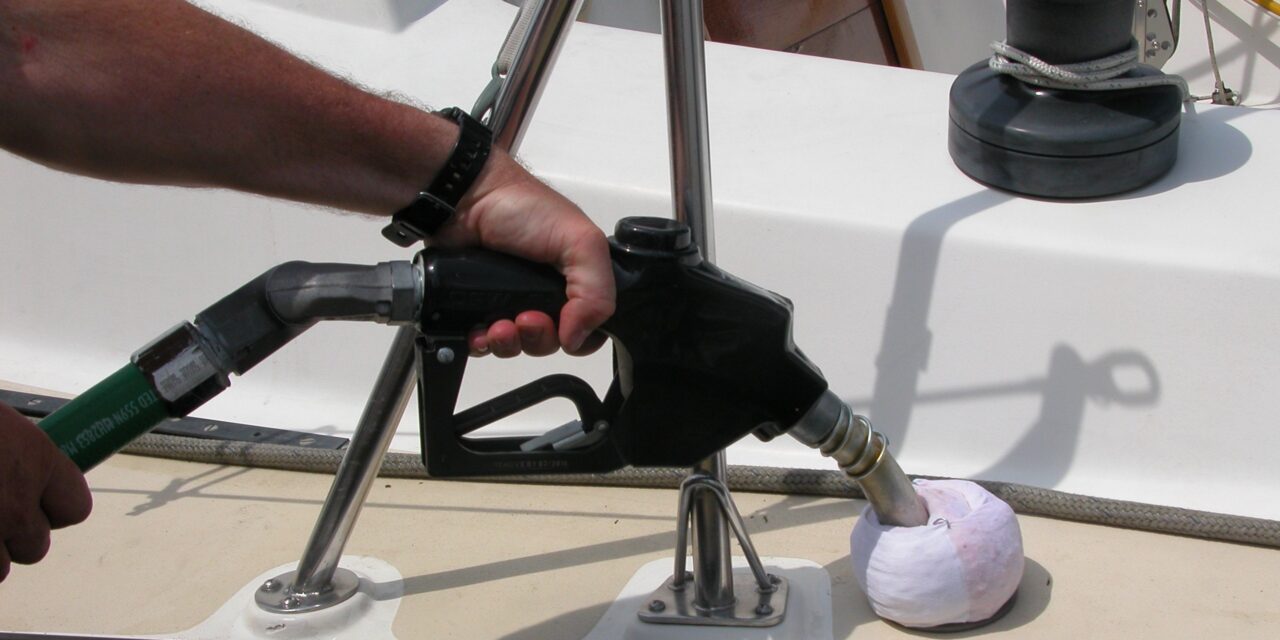
On the outside deck there will be one or more fuel filling ports. These are closed from the marine environment by screw on caps. These caps use O-rings to seal the access from external contaminates. Water entering these ports is a contaminate and will kill your engine. Keep your O-rings in good repair. Replace at regular intervals.
2) Fuel storage tanks
Tanks come in different shapes, sizes and made of different materials. They have common system features. A hose connecting the outside access. A vent to let air in the tanks escape as the in-flowing fuel displaces the air. A hole to house a fuel measuring sensor. A hole for an access tube to draw out the fuel to feed the engine. A hole for a hose to return excess fuel to the tank.
3) Fuel lines
The hoses and fuel lines transport fuel from the access point to the storage tanks, through to filters, pumps, engine and back to the storage tanks. These fuel hoses are as critical as your blood vessels. If one develops a leak your boat may suffer a stink or worse a life threatening emergency. Care and maintenance is required of the hoses and all of the connectors.
4) Fuel Pumps
Two basic types of pumps keep your engine running. Low pressure pumps pull fuel from your tanks and feed it into your engine. Fuel is moved to the high pressure pump where the fuel is pushed to the injectors. The injector measures the amount of fuel needed for a combustive air/fuel mix and sloughs off any extra fuel. This extra fuel is sent back to the storage tank.
5) Fuel filters
These marvelous tools sit in the fuel line between the tank and the engine. They remove impurities like dirt, sand, water and biological debris from the fuel. Clean fuel is required by your engine.
6) Injectors
Injectors are where magic occurs. Pressurized fuel is forced through tiny holes. It sprays like mist into the combustion chamber. The pistons rise to compress the air/fuel mist until it ignites, expanding into the cylinder driving the piston down, powering your boat.
This cycle repeats giving your boat it’s Vroom. If something interrupts this system, the Vroom stops and the boat with you on board sits bobbing in the water.
While many things can interrupt our fuel systems, contamination is one of the most common. There are multiple ways your fuel can become contaminated.
- Water, dirt, and sand can enter the fuel system through an open access port.
- The fuel you put in the boat may be contaminated with particulates or water from your fuel source.
- Leaking fuel lines or connections may suck contaminates into your fuel lines.
- Your tanks may have sat idle for long periods with contaminates in the fuel, i.e water. Water and diesel oil do not mix. Yet this is an ideal environment for microbes that thrive in this water diesel oil environment to multiply. Growing and dying by the millions.
Whatever path the contamination takes, it is a clear and present danger to the health of your engine.
You need a way to identify contamination presence, capture it, and clear it from your system.
When I bought my boat, I knew it had been a couple of years since the boat sailed away from a dock. On inspection of the two 85-gallon tanks, I had maybe 130 gallons of diesel in them. On my first cruise, as I was leaving the slip, the seller warned I might want to put a few “fresh” gallons in the tank. Ok I said, as I swung the boat out into the fairway. I stopped at a nearby fuel source and pumped 25 gallons into the tank. All worked as hoped. I took 2 powered trips in the first 10 days of boat ownership. The first was to celebrate my new boat and the second was to position the boat in its new home. They both went off without any issues. On my third trip, an hour away from the marina, the engine acted up. It sputtered. Then the engine raced, rpms rising. It sputtered then died. It would not restart. I was baffled. What had caused my running engine too die. I got a tow to port. The next day I learned that the engine had stopped due to a clogged fuel filter. Clogged with what looked like coffee grounds. This began my quest for answers. I learned about fuel contamination. The strange term “fuel polishing”. The different types of pumps and filters. I discovered how difficult it is to change a truck filter from the late 70’s (the filter on my new to me boat) without spilling diesel fuel everywhere. Diesel fuel sure stinks. The smell of diesel gets everywhere. Makes you want to drink cheap whiskey till you are away from the boat, because the whiskey will taste like diesel flavored whiskey.
I knew I had to change this antique system on my boat, if I wanted to keep the engine running. I knew I had 150 plus gallons of fuel that was priced at about $5.50 a gallon. What new boat owner can throw away $825 of fuel that appears bad.
Necessity led me to understanding the issues and to look for a method to keep fuel clean and filtered. I want my engine to run on demand.
I discovered filters are cheap. They can be replaced quickly and without fuel spilling everywhere, if the filter housing is of proper design. I learned changing a filter can let air enter fuel lines potentially causing the engine pumps to stop working. You need a way to bleed the air out of the fuel line to get the engine to run. This requires a way to pump the air out of the fuel lines.
Water will get into the fuel on a boat. It is only a matter of time. You need a way to identify when this happens so you can deal with it. Water in fuel invites “fuel Bug” action. Like it or not, they are there waiting. They reproduce like rabbits. They clog fuel lines, build up on tank surfaces, clog filters and damage your tanks.
You need a way to identify the problems so you can address the issue.
I MacGyvered parts of a system together and was able to address the problem well enough to keep my boat running. It required a lot of work to keep all the parts functioning. It was not elegant, but it served to keep me playing on the water.
Then, 3 months ago while in the marina, I was flipping pages of the magazine Latitude 38. An advertisement caught my eye. A unit in a single compact package that contained the filter, pump, manifold, and sensors to elegantly address the idea of diesel fuel management.
That ad was for the Keenan Fuel Management system. It is that “elegant” designed tool I was seeking.
What makes up the Keenan Fuel Management system?
- A fuel management manifold that lets you control the flow of your fuel.
- A state-of-the-art filtration system that combines a readily available filter insert with improved vortex separation, O-ring seals and a vacuum gauge.
- Sensors provide an early warning notice that your fuel system has been invaded and needs your attention. The sensors also save you money from needless filter change expense just because you lost count of the last filter change.
- Best of all, the system lets you manage your own fuel cleaning should your fuel fill up introduce contamination.
- While this is not an install-and-forget tool, it is a system that lets you focus more time on cruising and less on fuel system worries.
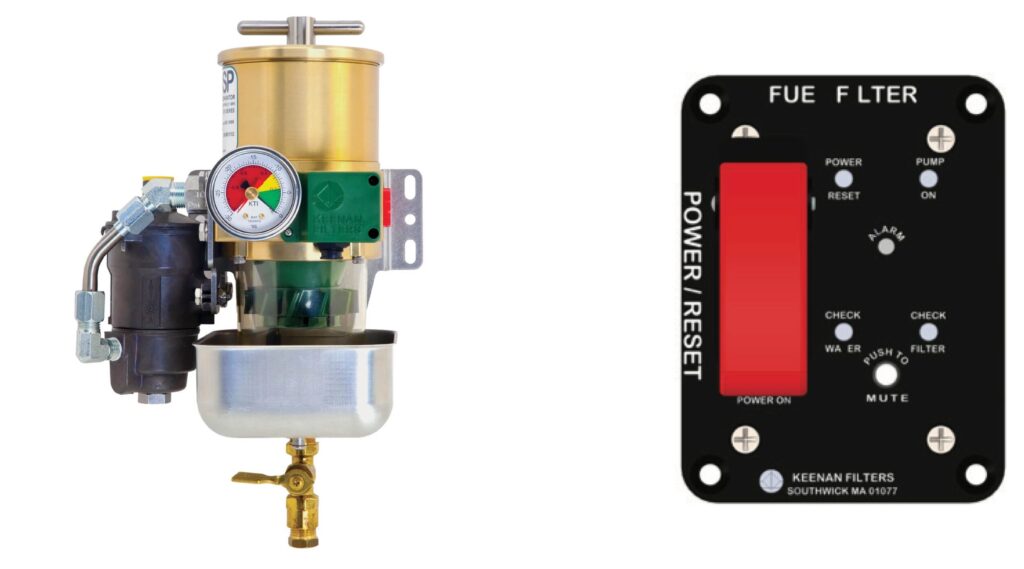
The warning control panel is designed to give the skipper notice of both water and high vacuum filter clogging. The unit sounds an alarm and identifies the issue with warning lights.
- Water in the fuel / Clogged filter / Prime pump turned on
- All of the fuel management critical issues that hide from regular view are monitored
Changing your fuel filter only when there is an issue saves both time and money… freeing the skipper to do more of what they enjoy.
On my 35-foot boat with a single diesel engine the MK60SP system was the compact, elegantly designed system I desired.
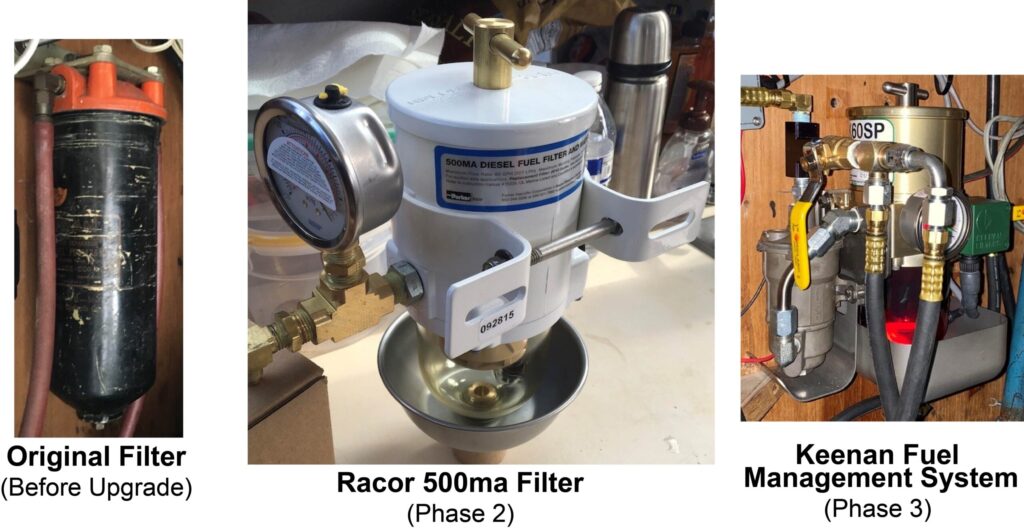
The new package fits neatly in the space of my previous Racor system.
Now I can polish my fuel, bleed / prime my fuel system after filter changes, have a backup fuel pump should my low-pressure engine pump fail, and transfer fuel between the two tanks on my boat.
Most diesel engine failures start in the fuel tank.
Diesel fuel is unstable by nature. Solids begin to form and the sludge that accumulates can eventually clog your diesel filters and may ruin your injectors, causing your engine to stop.
Every engine runs better with a system that cleans fuel, removes water, tests for leaks, and senses when it’s time for service.
I have been refitting my boat to address its weaknesses and improve on its strengths to be able to go cruising on to remote waters of the Pacific NW. To do this safely you need to have reliable systems that help you take care of the boat in an efficient manner. This Keenan system solves my issue, reliable clean fuel for my auxiliary engine.
Learning in advance that the filter is having a problem, or my fuel is contaminated means I can schedule time in a safe anchorage where it is safe to address the issue.
At this point it sure looks like the system checks the boxes of an elegant solution to a problem that plagues sailors of small boats with auxiliary diesel engines.
Written by John Shepard
Header Photo by BoatUS