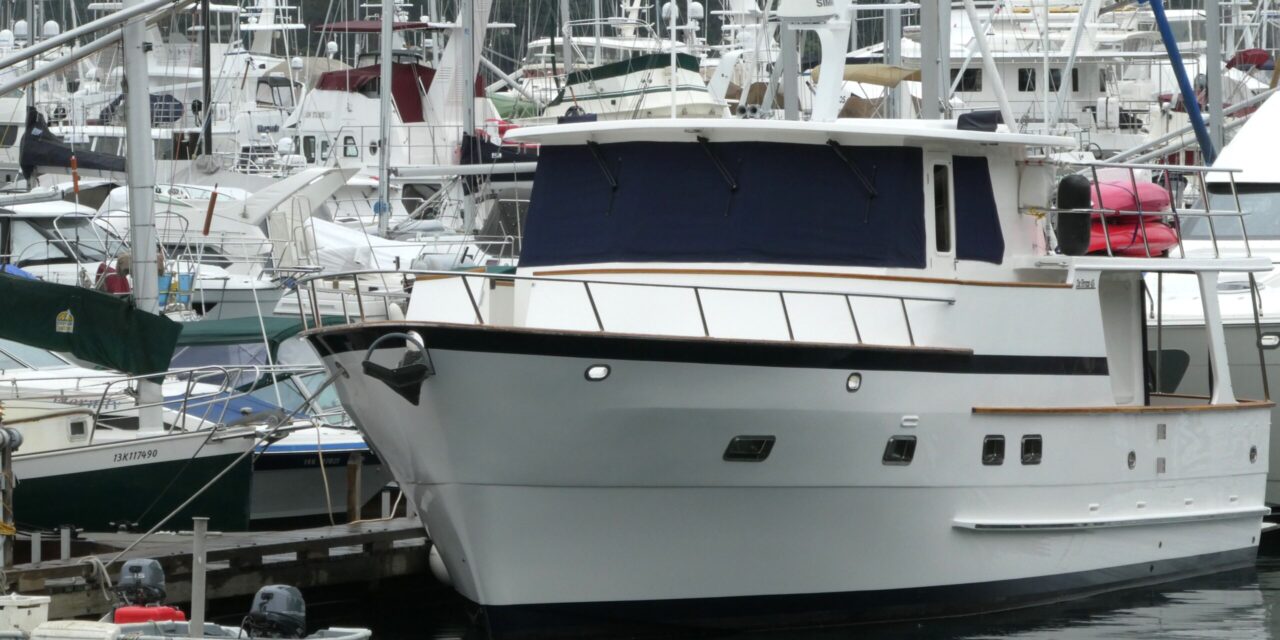
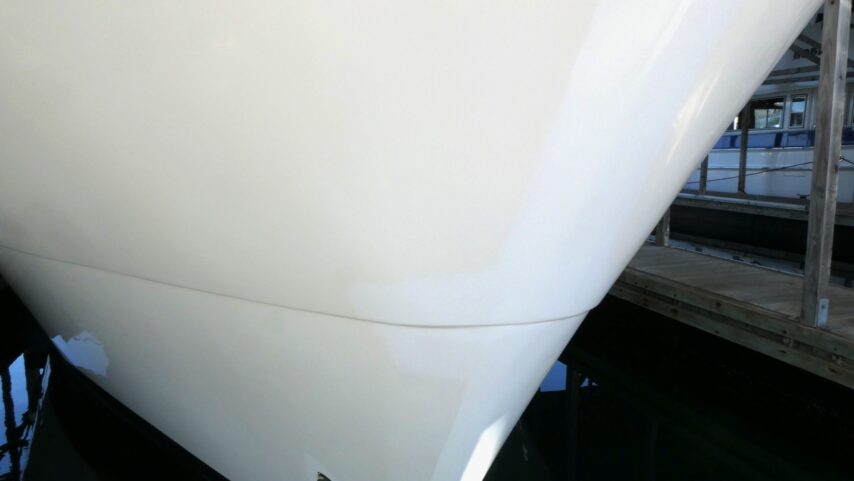
When we purchased our 2004 DeFever pilothouse trawler, we named her Got d’ Fever, a play on words to identify our DeFever make boat, our feverish love for boating, and the vessel itself had the look of a fever with two different fiberglass shades of white (a manufacturing defect).
The Decision. While the two different shades of white on the hull did not affect the performance of our coastal cruiser, the variance in color became more prominent over time. The two-tone effect occasionally became conversation starters with other boaters, leading to some fun exchanges.
As with all gelcoat, overtime it was losing its shine, and with the two-tone more noticeable, this prompted the question, do we purchase a new boat, or do we have the hull of Got d’ Fever painted? Our reasoning went something like this: we know how she handles in different sea conditions; we have kept her John Deere engines and boat systems well-maintained; and her interior is decorated to our liking with Pacific Northwest décor.
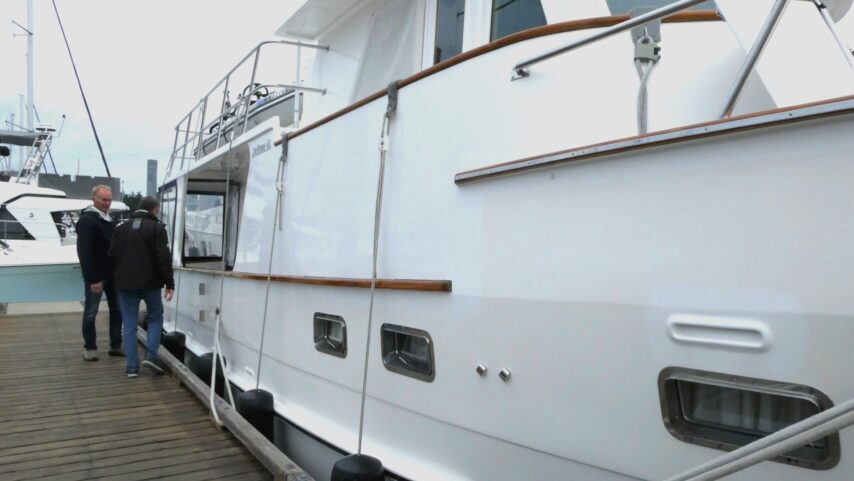
While having a boat painted is not cheap, it is far less expensive than buying a new boat. And best of all, an older boat will look shiny and new after having been professionally painted. No waxing necessary, in fact, we were told not to wax the painted portion of the boat, simply wash with mild boat soap. This cuts down the hours one has to spend on waxing large areas of a boat.
House areas and Portuguese bridge areas of the boat did not need painting. However, the transition between the painted and unpainted areas required some design consideration. After help from Jamie at Philbrook’s Boatyard in Sidney BC, we decided to add a dark blue accent stripe below the gunwale from the bow to nearly the length of the boat, this created a nice modern, fresh look for Got d’ Fever, with a matching-colored boot stripe.
Choosing a Boatyard. Finding the right boatyard to do the work was an important step. We prepared a “Bid Specs” package with photos and a boat diagram with dimensions and a list of hawseholes, portholes, gates, and hardware that needed to be removed. We emailed the Bid Specs to several boatyards for estimates. Not all boatyards are setup for boat painting projects and those that are experienced are in demand. About one-third of the boatyards that received our Bid Specs responded with estimates. Responder schedules for taking our project were out many months, if not sometime next year. The turnaround time and the length of time the project would take was a key factor in our decision. Project time estimates ranged from 3 to 6 weeks.
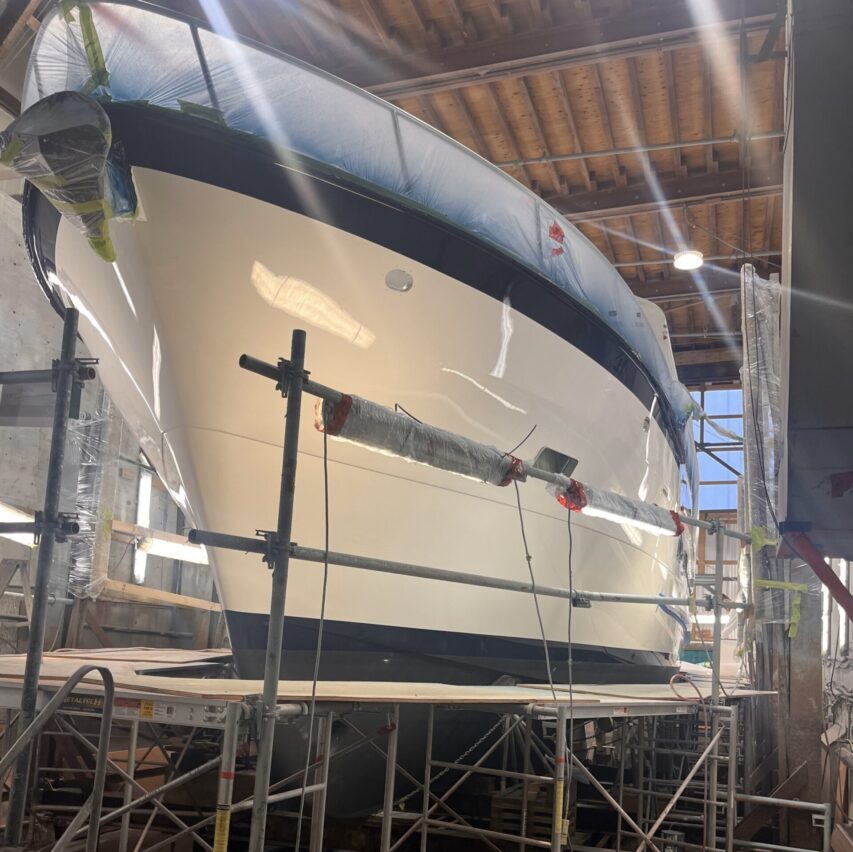
We chose Philbrook’s Boatyard at Van Isle Marina in Sidney, BC for a number of reasons: 1) boat painting is among Philbrook’s major services at their indoor facility, 2) Philbrook’s, a Waggoner advertiser, has a good reputation for exceptional vessel services, 3) they could take our boat in the fall, good timing for us while we were busy putting together Waggoner publications, and 4) the Canada/U.S. exchange rate would work in our favor. Philbrook’s offers expertise in a wide variety of boat projects, including composite & fiberglass, metal fabrications, canvas & upholstery, electrical & electronics, painting & varnishing, detailing, and other maintenance services.
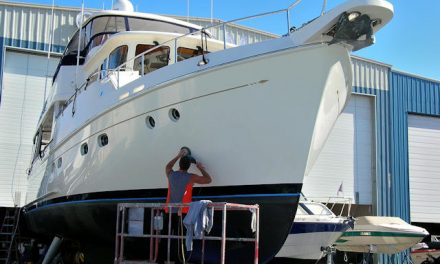
Progress and Transformation. Throughout the project, Jamie, our project manager at Philbrook’s texted and emailed us with almost daily reports including photos and videos. Through these progress reports, we discovered the considerable time and labor needed to do a quality paint job. After haul out, the boat was blocked in their huge indoor facility. Scaffolding was erected to provide access to the entire area of the boat’s eight-foot bow freeboard. The boat’s three gates, two sides and one transom gate, were removed, along with hawse and porthole covers, and splash rail stainless trim. Small fiberglass cracks at the three gate locations were repaired before sanding began. The entire hull area was sanded before a primer coat of paint was applied. Jamie’s photos with the primer coat showed the extent of prep-work needed for quality finish. Jamie’s next set of photos helped us understand the incredible time and work that goes into a good paintjob. The next photos showed a completely clean boat and scaffolding with fresh, new masking tape, and plastic sheeting.
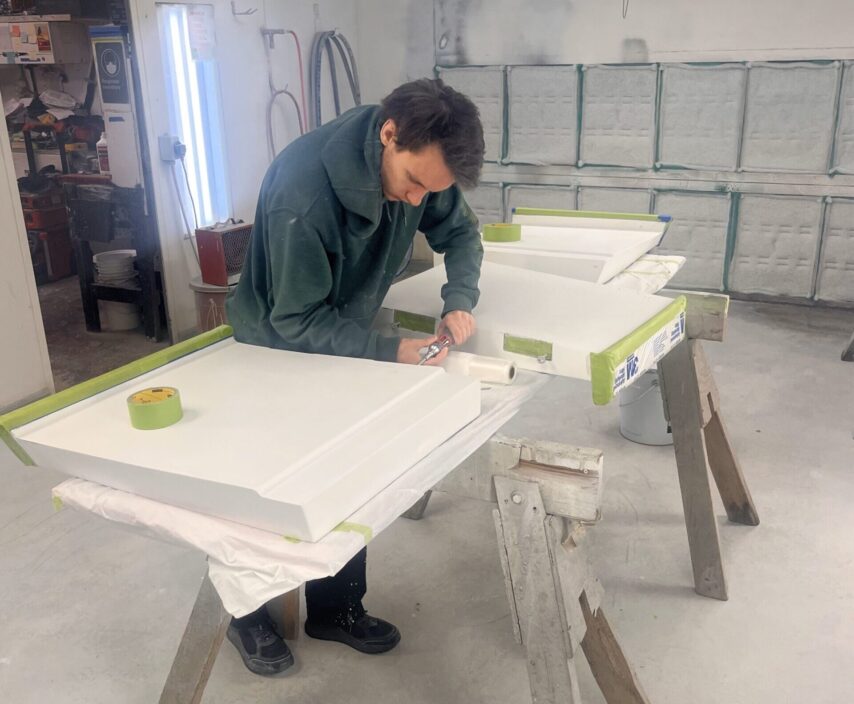
The entire area was washed and re-masked to prepare for the first coat of Awlgrip paint. After several coats of final white finish, they prepared the area for the dark blue boot stripe and accent stripe. After the final coats of white and accent stripes, they replaced the porthole trim, hawsehole trim, side and transom gates, and affixed the new transom stencil.
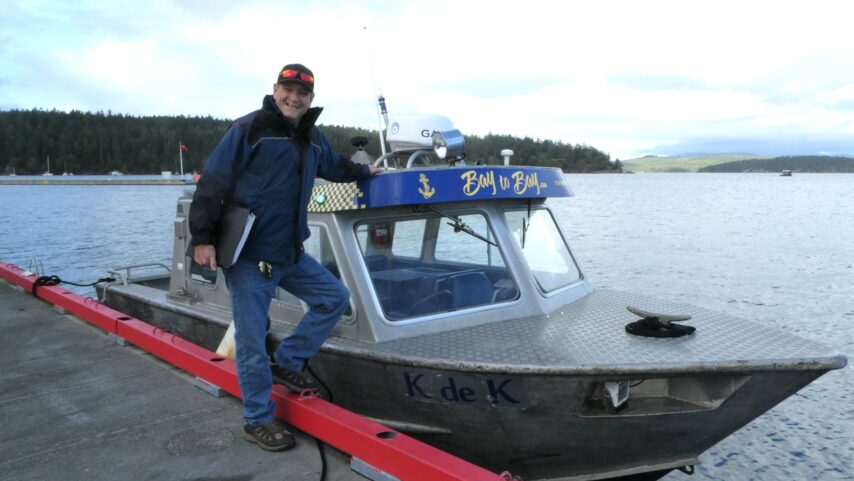
Transportation Logistics. You might be wondering about transportation logistics for delivering and picking up our vessel. After clearing customs at Van Isle Marina and delivering our boat to Philbrook’s boatyard, Jamie our project manager, had arranged for the “Bay to Bay” water taxi to take us to Friday Harbor, WA on San Juan Island. The water taxi was not cheap, but we thoroughly enjoyed visiting with Miles, our taxi captain, about his taxi business. We chalked it up to an enjoyable experience, after all, life is about experiences. When it came time to pick up our vessel, we did the trip in reverse via the ferry from Anacortes to Friday Harbor, then ground taxi to Roche Harbor, where Jamie from Philbrook’s picked us up.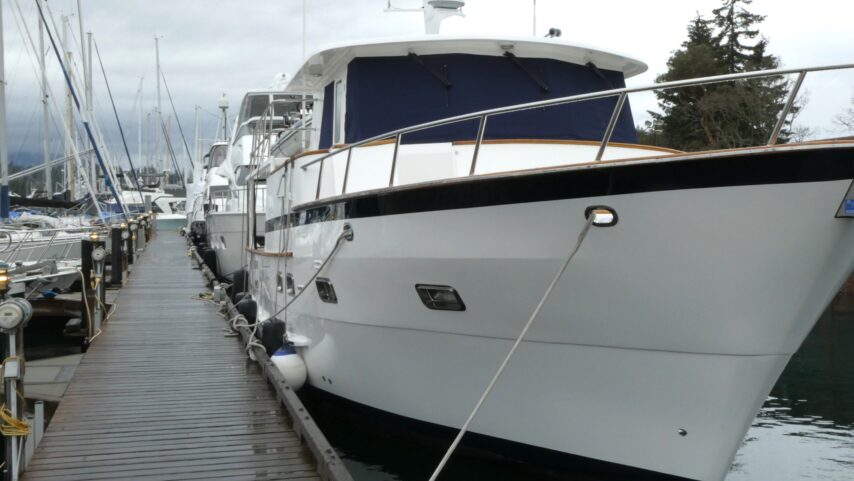
That Special Moment. After clearing customs at Van Isle, we rounded the corner to Philbrook’s boatyard. Got d’ Fever was waiting for us, proudly sporting her new look, with a shiny glow. It’s a whole new boat for us thanks to the expertise of the skilled technicians at Philbrook’s.
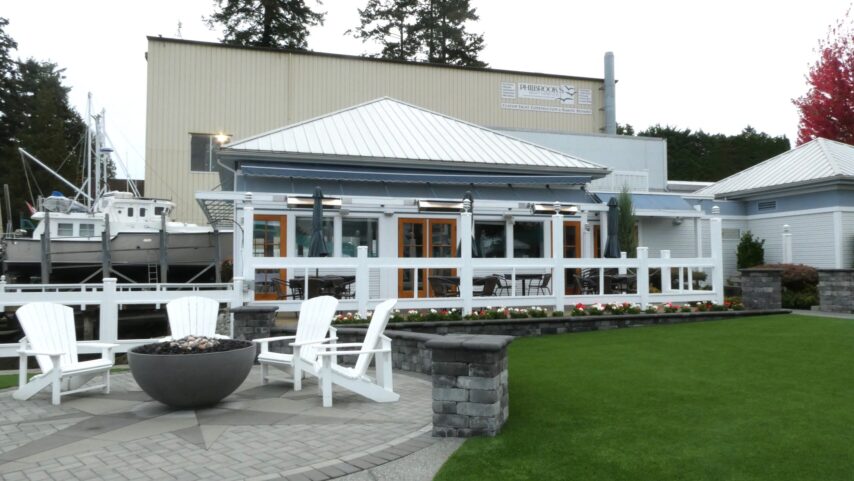
Getting Her Home. The seas were rather rough the day we arrived, with 40 knot winds predicted for the following day. No problem, we stayed aboard Got d’ Fever to wait out the weather at Philbrook’s dock provided for their customers. We purchased a few food items at a nearby convenience store and enjoyed an excellent dinner at the Sea & Glass Waterfront Grill, located next door to Philbrook’s.
Our Sunday departure was in settled seas, however, we discovered an obstacle course of logs and debris. Due to the previous windy conditions, rain, and high tides, we had to maneuver around numerous logs, trees, and debris throughout our journey home, being extra careful with our newly painted boat! Thankfully, there were no unpleasant encounters with logs, it was slow as you go and out of gear when needed.
Required E29B CBSA Form. If you are bringing a boat into B.C. to leave in a boatyard for work to be done, owners of the boat must sign a E29B CBSA form, otherwise sales tax would be owed by the vessel owner. Philbrook’s provided us with this form, which we signed and they sent the signed form on to CBSA on our behalf. When crossing the border into B.C., we reported to the customs agent that we were bringing the boat into Canada for boat repairs/work and that we had an E29B. After returning home to U.S. waters, we reported our U.S. customs clearance number to Philbrook’s so that they could close out the E29B Form on our behalf. All easily done. Should the owner fail to confirm and follow these steps, it would be the owner’s responsibility for taxes owing.
In Summary. Philbrook’s provided a surprisingly accurate estimate for the painting project. Their reputation for providing nearly-spot-on estimates comes from their experience of dealing with many boat types and sizes. We appreciated being kept abreast of the progress and timing for completion of our boat project, which took about 5 weeks. We were provided with excellent progress reports, photos, and videos throughout the project.
Photos: Lorena Landon
and Philbrook’s Boatyard