In mid-November 2022, Hilary Franz, Commissioner of Public Lands, announced that commercial finfish net pens would be prohibited on state-owned aquatic lands managed by DNR (Department of Natural Resources). Environmental studies and reports have determined that finfish net pens negatively affect the ecosystem and that Atlantic salmon can transmit disease to wild salmon that migrate past the open net fish farm pens.
Commissioner Franz’ executive order is in keeping with aquaculture policies already in place in California, Oregon, and Alaska. Commercial finfish farming has operated in marine net pens in Puget Sound for more than 40 years on leased aquatic lands. DNR staff is now being directed to develop necessary changes to agency rules, policies, and procedures to prohibit commercial finfish aquaculture on DNR aquatic lands. The order applies only to commercial net pen finfish and does not apply to hatcheries that restore or boost native stocks.
The new policy is supported by the Wild Fish Conservancy and many local Native tribes, including the Suquamish Tribe, the Lummi Nation, Tulalip Tribes, Samish Indian Nation, and the Swinomish Indian Tribal Community, all of whom have expressed their appreciation for this bold action.
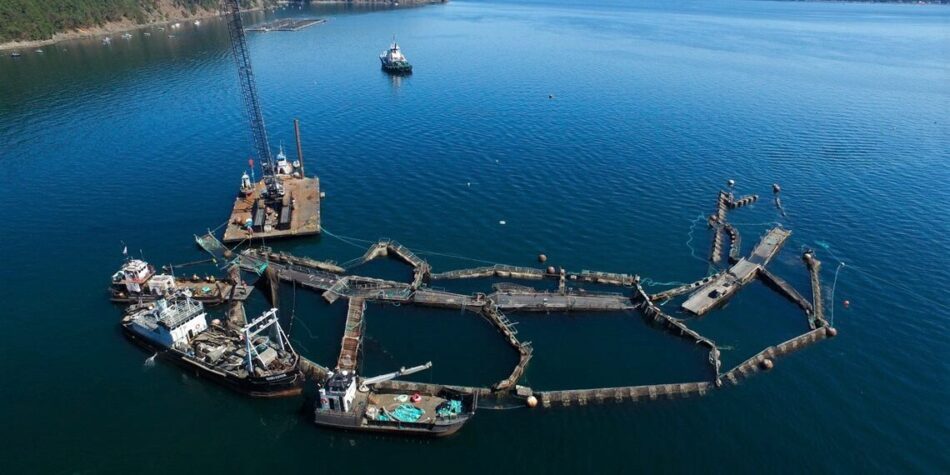
The policy action was driven by the collapse of the Cooke fish pens at Cypress Island in 2017, when thousands of Atlantic salmon made their way into Puget Sound. The company was fined and found negligent by the State Department of Ecology. Leases for two remaining finfish Cooke net pen facilities were not renewed by DNR when they came due in March and November of 2022 – Hope Island in Skagit Bay and Rich Passage off Bainbridge Island. The Cooke Aquaculture Pacific Company has until December 14 to finish operations and begin removing its facilities.
Hilary Franz’ executive order means state-owned aquatic lands will no longer be used for net pen fish farming. While aquaculture advocates say the Cypress Island collapse had no effect on native fish, proponents of the new policy are hopeful that this step will protect the habitat of native salmon and the health of the Salish Sea.
Photo Credit: DNR, Broken fish pens off Cypress Island