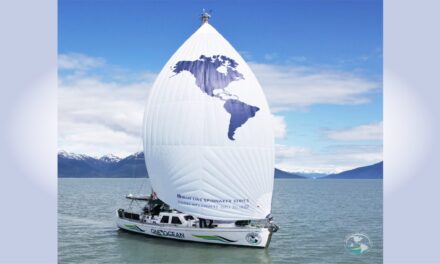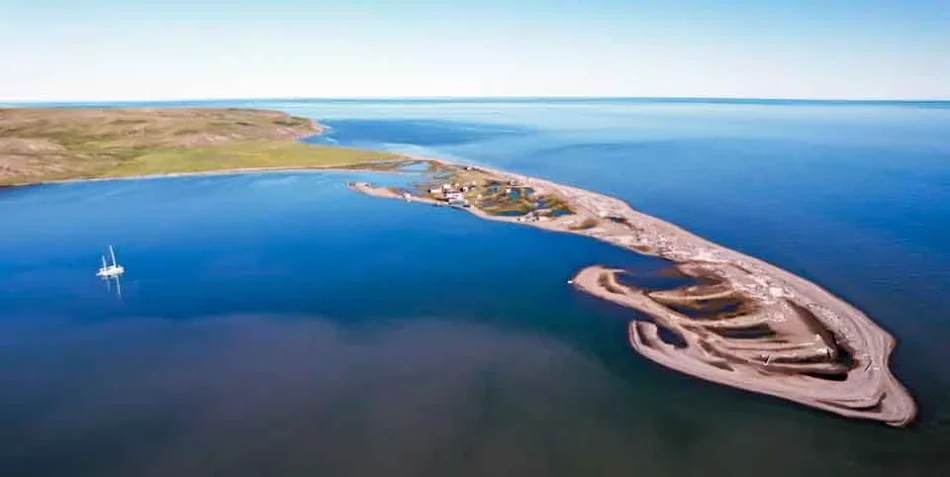
Waggoner congratulates the crew of s/v One Ocean for a successful completion of transiting the Northwest Passage, a journey with untold challenges, which they overcame with purpose and careful planning. Below are excerpts from Captain Mark Schrader’s blog and Co-Captain Jennifer Dalton’s blog.
A Successful Transit – Challenges Overcome
We’re sitting in a small semi-sheltered arctic bay discovered and named (False Strait!) by someone else (probably early 1700s), securely anchored between two nearly vertical rocky ridges, created by something else (millions of years ago) rising hundreds of feet above of our mast. We chose this bay for a couple of reasons, proximity to Bellot Strait – our exit route from the Northwest Passage, and weather. Predictions for last night, today and tomorrow suggested we should find a place to hide for at least 36 hours. Force 6/7/8 winds (25-46kts), easterly, veering northerly for 24/36 hours meant finding a place with good anchor holding, sheltered from east, northeast and north winds if we wanted to relax and enjoy the experience. Did I mention snow? Everything visible this morning was covered with snow. Ice on our rigging, sails, decks and windows with wind noise at a pleasant but steady level makes us feel pretty thankful for our comfortable and heated little capsule.
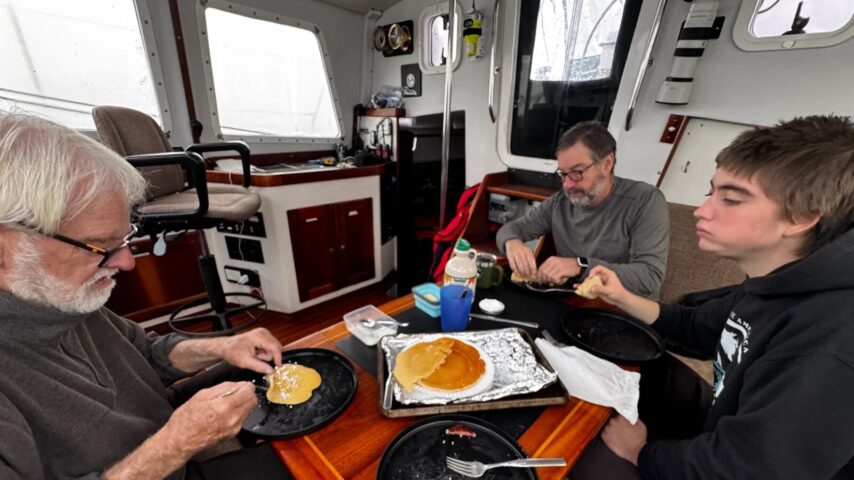
All of this weather and scenery (except for the mountains and water) made me feel like I was waking up to a typical winter farm day in Nebraska – so I made breakfast pancakes for everyone. Given the Canadian influence on board Oo my Nebraska cakes turned into Canadian pancakes. Apparently, food nationality changes when syrup is replaced by powdered sugar and lemon juice is added before the whole thing is neatly rolled and eaten. Spam as a side appears to be international – fried and flat, a poor substitute for bacon but we are in the Arctic, very close to where Franklin and his men still reside, and we are not having to eat our shoe leather to survive.
Fifteen years ago, we piloted Ocean Watch through Bellot Strait after weaving our way through ice, wind and freezing water from Cambridge Bay to the western entrance of Bellot. That route took us to the south end of King William Island and the community of Gjoa Haven, the wintering base for Roald Amundsen during the first successful transit of the Northwest Passage (1903-1907). It is also very close to the place where the Franklin ships and crew were lost to the ice. We chose that route in 2009 because the west side of King William was completely blocked by ice. Our intention this time was to follow our 2009 route. However, a more direct route via Victoria Strait became ice free just a week ago and was completely open all the way to Bellot, saving many miles/hours to Bellot Strait.
I wanted to go to Gjoa Haven so the rest of the crew could experience a bit of what Amundsen and his crew experienced. Amundsen’s achievement was truly remarkable – small ship, small crew and all willing to learn the ways of the Innuit to survive in an incredibly harsh environment. The Norwegian’s welcomed and learned from the natives. According to the accounts from historians, the British not so much. To stand on the ground where Amundsen and his men lived, worked and explored for almost three years and to appreciate their efforts seemed like an experience one shouldn’t miss. So, we stopped there again in spirit and hoisted a small ration of rum (very short supply) to their commitment and fortitude.
By Captain Mark Schraeder
Photos: Crew of One Ocean
Leaving the Northwest Passage
We departed Fort Ross, on the east side of Bellot Strait, early Tuesday morning, September 2 and passed our first official icebergs. Not floes or sheets like the ones we navigated earlier, but true icebergs. Sea ice forms when ocean water freezes into flat sheets that drift with wind and current. Icebergs, by contrast, are calved from glaciers—immense freshwater mountains, most of their mass hidden below the surface. I was at the helm when Mike pointed out what looked like an island emerging through low clouds. But it wasn’t on the charts. Through binoculars we realized it was ice—massive; the phrase “tip of the iceberg” never felt so literal.
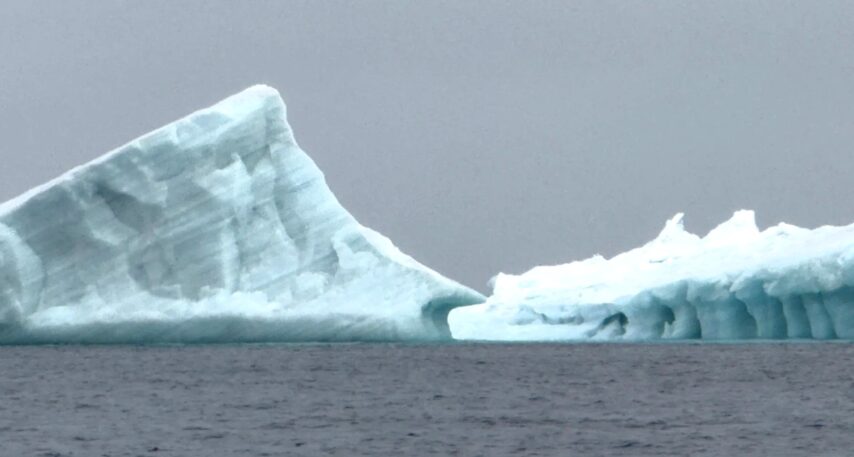
Once Mike took the helm, I bundled up and went out into the 27-degree air (not including windchill) to take photos and send them to Harry Stern, our polar ice scientist mentor at the University of Washington. Harry confirmed what we suspected: real icebergs, flowing south from the Humboldt and Petermann glaciers down Prince Regent Inlet. I hadn’t expected to see them so soon.
But that is the Northwest Passage – expect the unexpected with unknowns and surprises at every turn. After two challenging, unforgettable months, we were just days from exiting. The rewards have been immense: spectacular sights, generous people, unforgettable moments. But the Passage demanded everything of us — from areas not surveyed, endless ice and fog, to winds that kept us on edge.
Crossing the Northwest Passage was a feat—but more than that, it was a purpose. We saw climate change firsthand and listened to the voices of those living with the consequences. We saw glimpses this summer of Chinese “research” vessels off Utqiagvik, Russian and Chinese ships testing Arctic trade routes. A reminder that as the ice retreats, the competition for control only grows.
By Jennifer Dalton
To read more of their encounters, go HERE.
Header Photo: Jenn Dalton, Herschel Island suffering from thawing
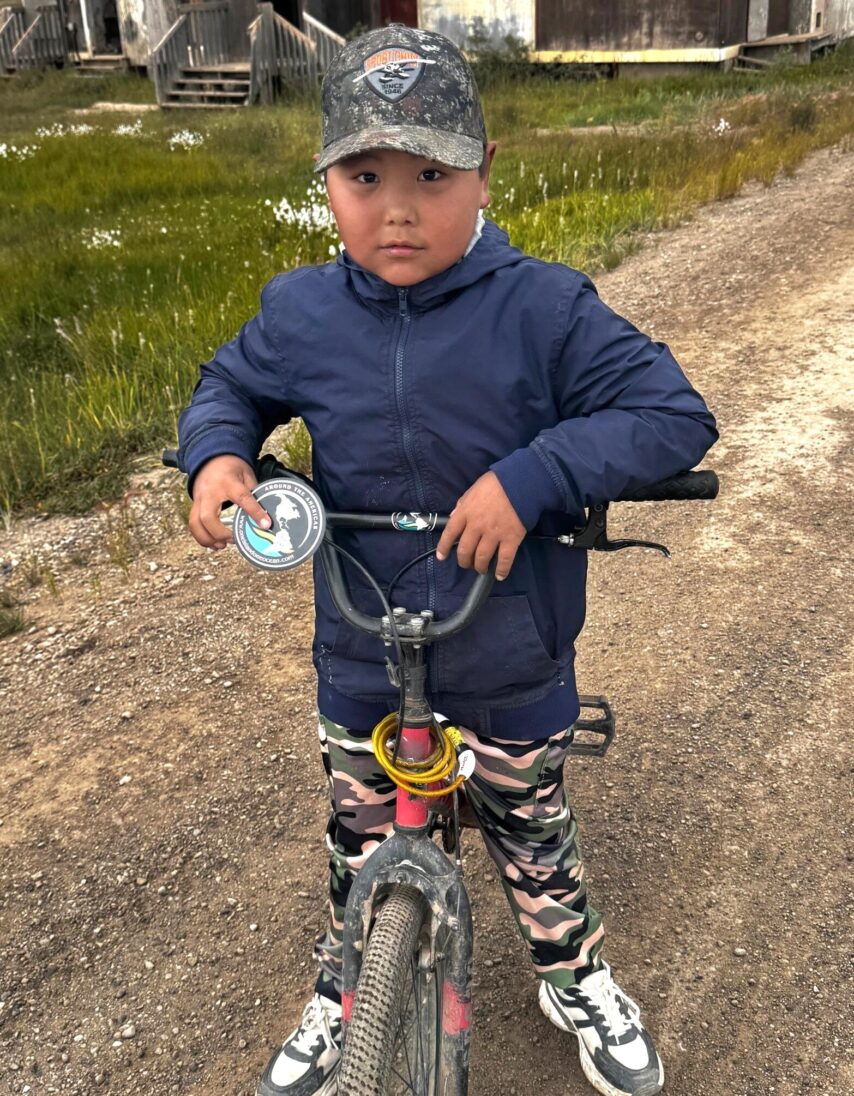
Text Photo: Boy Conrad giving a tour of Tuktoyaktuk