Berlin, Germany. Berliners can now travel from the city’s eastern center to Oberschoneweide in just 10 minutes via the Spree waterway thanks to the new P-12 shuttle electric ferry line. The electric hydrofoil catamaran connects the East Side Gallery, near Ostbahnhof, with the cultural hub Funkhaus.
The electric hydrofoil catamaran can travel at 25 knots and is the fastest electric vessel in the world and the first of its kind in Germany. Berlin is a city with lots of water and has a long history of water transport. Since the 19th century, steamships have carried Berliners and Berlin tourists through the city. It is one of the most beautiful ways to experience Berlin, yet until recently, it was unused for public transport. Vehicle traffic and inconvenient connections, prompted Berlin officials to reduce congestion on the roads and the harmful emissions of vehicles.
The Swedish ship manufacturer Candela utilized computer-stabilized underwater wings to raise the hull above the water, cutting energy consumption by 80 percent. The P-12 is the first electric vessel with both long range and high speed. Due to the hydrofoil technology, damaging wakes are nil to none and thus earned the exemption from speed limits that other vessels must adhere to. Its low energy use enables the P-12 to replenish its battery from a conventional car DC charger in just an hour.
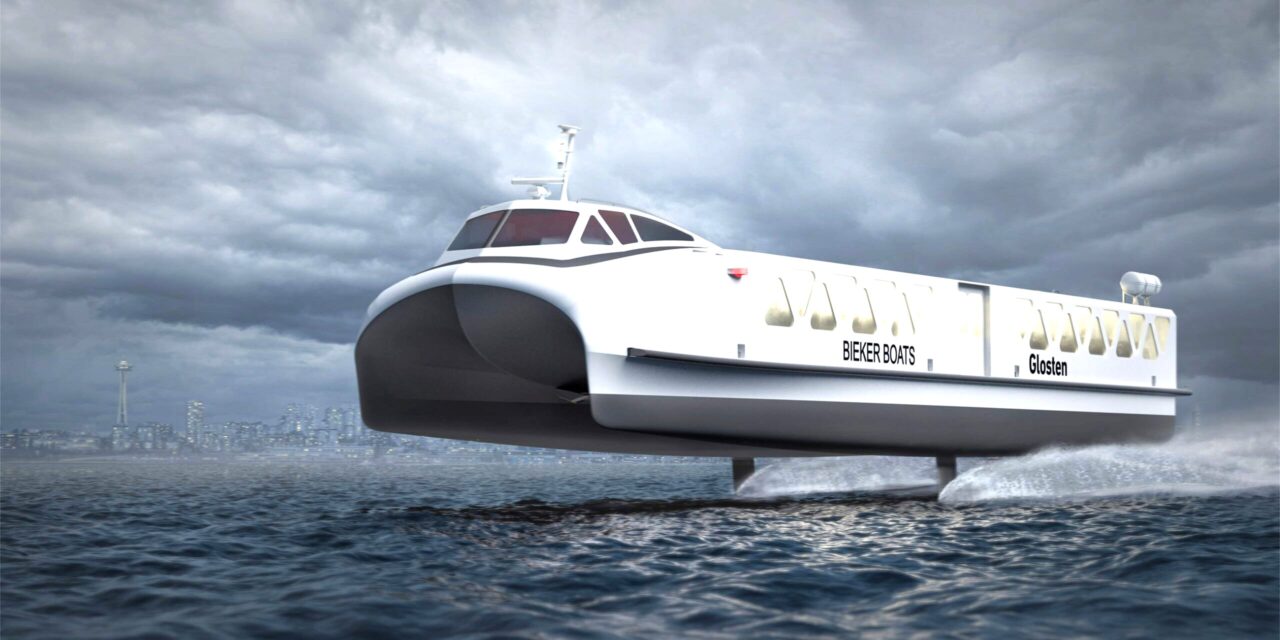
Washington’s Kitsap Transit Electric Ferry. Kitsap Transit has announced that they are one of 25 transit authorities nationwide that will receive a share of approximately $14 million in funding through the Accelerating Innovative Mobility Initiative. The Washington State Dept. of Commerce recently announced that Kitsap Transit will receive $1.2 million for the design of an all-electric, zero-emission fast ferry demonstration vessel and its shoreside charging infrastructure. The grant builds upon a $4 million State Legislature grant that will help pay for the design of the demonstration vessel. The demonstration vessel is intended to prove the viability of the technology and prepare the way for an all-electric hydrofoil fast ferry to operate on Puget Sound. Kitsap Transit would seek federal funding to build the full-scale 150-passenger Foil Ferry. Federal funding would be needed in order to bring the vision to fruition.
The public-private partnership team is being led by Washington Maritime Blue to advance the innovative fast foil ferry design. Led by Maritime Blue, the project advances work with regional companies, public agencies, and nonprofits to develop state-of-the-art technology. Cash contributions were committed by the Ports of Bellingham, Skagit County, and Anacortes. A total of $37 million was awarded through two clean energy programs to further the goals of Washington’s 2021 State Energy Strategy.
Kitsap Transit will work with Bieker Boats and Glosten to create the demonstration electric ferry. Bieker Boats (in Anacortes) and Glosten (in Bellingham and Seattle) have joined forces to bring hydrofoil technology to the passenger vessel community by combining hydrofoil technology, lightweight carbon fiber hull construction, and efficient geared propulsion. Bieker Boats is known for their creation of high-performance carbon fiber composite racing boats and has played a significant role in the evolution and refinement of high-performance hydrofoiling craft for the America’s Cup and the recreational market. Glosten is a full-service consulting firm of naval architects. The firm’s design experience includes research vessels, tugs, barges, passenger and car ferries, and special-purpose projects. Glosten is an industry leader in the design of hybrid and electric-propelled commercial vessels.
Photo: Bieker Boats