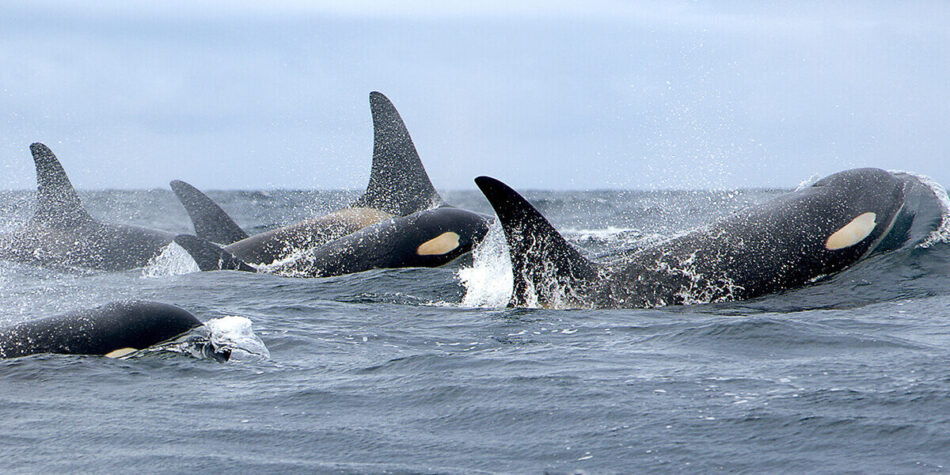
It has long been known that King salmon (chinook) is the critical diet for Southern Resident Killer Whales (SRKW), and the lack of chinook has been correlated with low birth rates among these endangered species. Until recently, however, no one has actually counted the chinook in the Southern Resident habitat.
While Southern Resident Killer Whales do face food shortages, these shortages do not seem to occur in the summer and fall, according to Dr. Andrew Trites, Director of the Marine Mammal Research Unit at the University of British Columbia. The three-year study of chinook abundance in the Salish Sea (2018-2022) under the direction of Dr. Trites brought some surprises. What they found was opposite of what they expected – “the prevalence of chinook was double in the Southern Resident Killer Whale habitat,” said Dr. Andrew Trites. His study included comparing the numbers of fish in the southern part of the Salish, with numbers in the northern part, where the killer whale population is actually growing.
The study, funded by Fisheries and Oceans Canada, may have changed some previously held conclusions. The concept of depleted salmon was the instigator of a lawsuit in 2020 that nearly put an end to chinook trolling in Southeast Alaska, the backbone of the State’s economy. Matt Donohoe, former president of the Alaska Trollers Association, feels that Dr. Trites’ paper is confirmation that the problem for Southern Residents is not in Alaska. Donohoe believes that the genuine threat is from marine contaminants. Dr. Trites says that perhaps the answer to the health of the Southern Resident Killer Whales lies outside that of the Salish Sea and may be found in the SRKW’s winter range. Maybe more attention should be given when SRKWs are not in the Salish Sea.
Photo: mmc.gov
Marine Mammal Commission