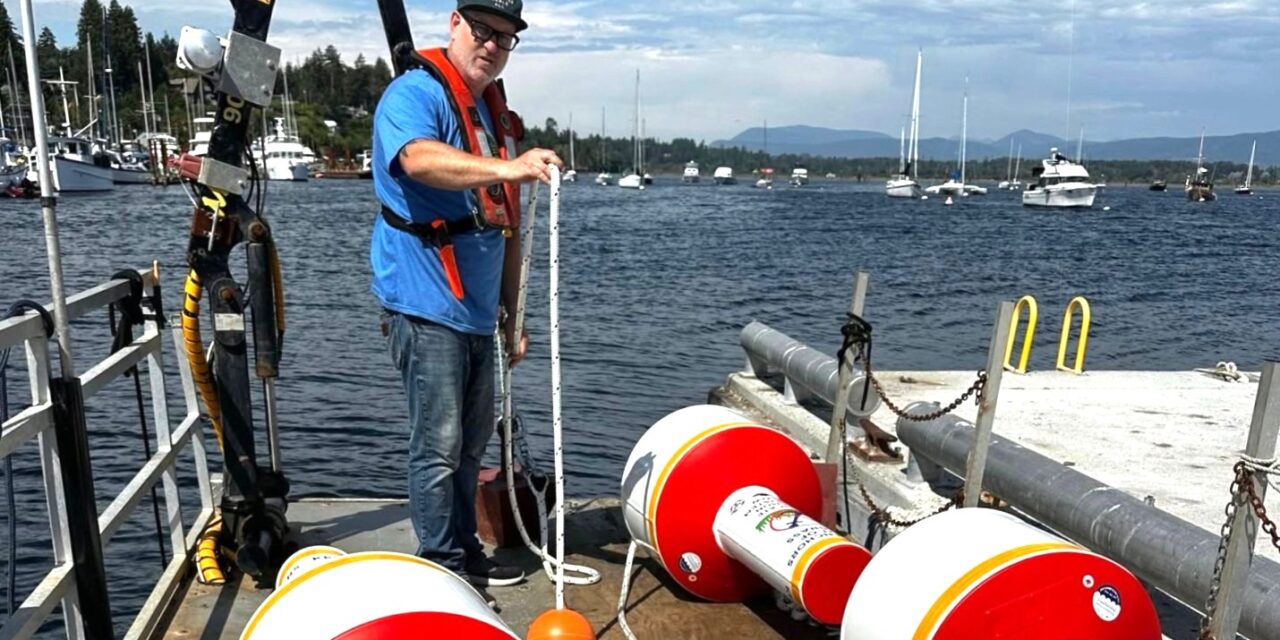
Cowichan Tribes Department of Lands and Self Governance has worked with a contractor to install markers in Cowichan Bay to denote voluntary no-anchor zones for the protection of eelgrass. In cooperation with SeaChange Marine Conservation Society, ongoing monitoring of eelgrass with underwater cameras and mapping has provided data showing areas needing eelgrass recovery. These marker buoys and no-anchor signs line the coast of Cowichan Bay for boaters and beach goers to help protect fragile eelgrass habitat.
The latest established no-anchor zone is located just east of the Fisherman’s Wharf breakwater in Cowichan Bay (approx. 200 ft. by 200 ft.). While there are still healthy eelgrass beds, the team has noticed the destruction of eelgrass meadows in the area over the past several years. There are contributing factors like various toxins and stormwater runoff that harm eelgrass, but boat anchors pulling and dislodging eelgrass also causes damage to established eelgrass beds. Murky water, dirt runoff, and boat activity can slow or even stop eelgrass growth so boaters are reminded to watch for the no-anchor zones.
According to SeaChange Marine Conservation Society, 1/3 of the global seagrass meadows have been lost in the last century, and an estimated 7% of seagrass habitat is lost annually worldwide. British Columbia has five species of seagrass that play critical roles in the ocean environment. Eelgrass meadows are highly effective when it comes to absorbing carbon. Eelgrass also serves as a buffer for coastal communities from the impacts of rising sea levels. And equally important, eelgrass provides a breeding ground for several marine species, including juvenile salmon, herring, and crabs.
Citizen scientists and boaters can help by uploading photos of your seagrass findings in British Columbia to iNaturalist in support of eelgrass monitoring. https://www.inaturalist.org/
Photo Credit: ChekNews